
Table of Contents
- How Smart Lights Fit Into a Professional DMX Rig
- Hardware You Need to Link Smart Lights and DMX
- DMXSmartLink Software Setup for Smart Light Patching
- Fixing Latency Issues With Wireless Smart Lights
- DMX Pixel Mapping for LED Installations
- Hybrid Rig Architecture: Smart Lights and Practical Fixtures Together
- Troubleshooting Common Connection and Sync Issues
- Frequently Asked Questions
Last Updated: September 11, 2026
How Smart Lights Fit Into a Professional DMX Rig
Using smart lights in professional DMX rigs means treating consumer fixtures as addressable channels your console already understands, not app-controlled gadgets running on the side.
DMX512 was built for wired, deterministic control; consumer smart lights were built for Wi-Fi convenience.
What DMX512 Actually Sends
DMX512 is a unidirectional serial protocol that broadcasts up to 512 channel values per universe at roughly 44 updates per second over a wired bus. (esta.org) Each channel carries an 8-bit value from 0 to 255, with no handshake or error correction.
Consumer smart lights rarely accept raw DMX values, they expect color commands, brightness percentages, or scene identifiers over a local network. Something must translate.
Where Consumer Fixtures Break the Chain
Consumer fixtures fail in a DMX rig for three predictable reasons:
- They have no XLR input, so they cannot physically join the daisy-chain
- Their internal refresh rate often sits below what broadcast cameras tolerate
- Their color engines interpret RGBW differently than professional fixtures do
None are dealbreakers, smart lights simply live in a parallel control layer rather than on the DMX cable.
Hardware You Need to Link Smart Lights and DMX
A working link needs three components: a DMX interface, a network connection, and software that speaks both protocols. The ESTA DMX512-A standard documentation defines the electrical and protocol requirements your interface must meet.
| Component | Purpose | Typical Connection |
|---|---|---|
| USB-to-DMX interface | Converts console output to DMX | USB to XLR |
| Network link | Carries Art-Net or sACN | Ethernet or Wi-Fi |
| Control software | Maps channels to smart fixtures | Host machine |
Daisy-Chaining, Signal Flow, and Voltage Drop
DMX daisy-chains have a hard practical limit: each fixture passes signal to the next, and every hop degrades it. Long runs without a splitter or repeater produce flicker, missed channels, and dropouts.
Keep runs under 300 meters per segment, terminate the last fixture with a 120-ohm terminator, and never exceed 32 devices per chain without a splitter.
DMXSmartLink Software Setup for Smart Light Patching
DMXSmartLink patches smart lights into your console as real DMX fixtures, keeping your workflow intact. It runs on Mac, PC, Raspberry Pi, or Linux, and supports Art-Net and sACN.
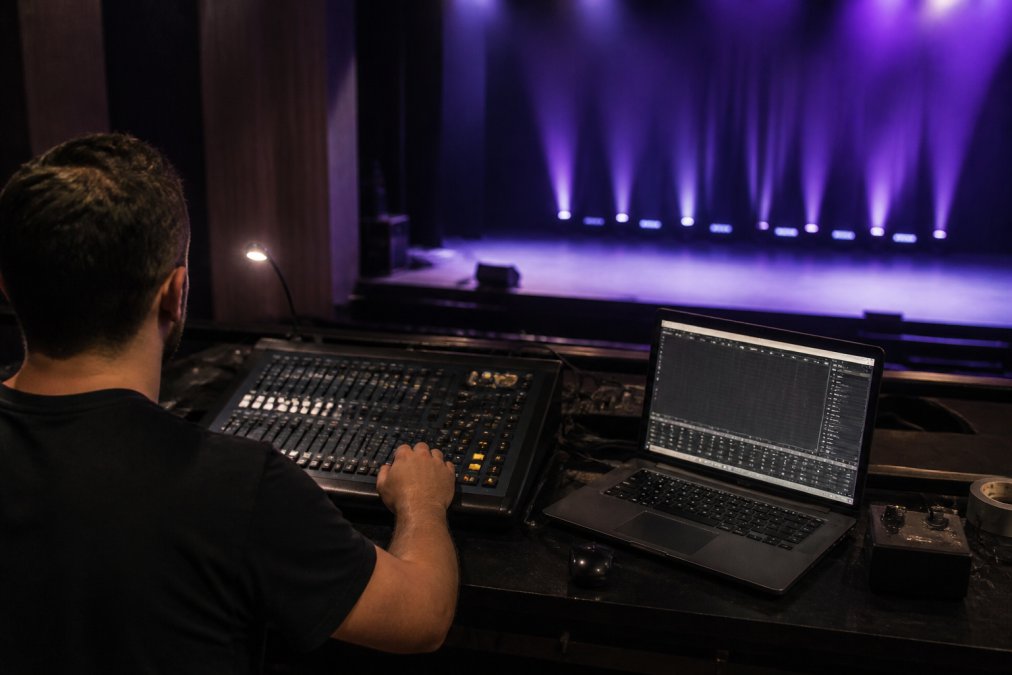
The process is short:
- Install DMXSmartLink and connect it to your network
- Add each smart fixture by its IP address or discovery
- Assign a universe and starting channel
- Load or build a fixture profile for the model
- Verify output on the console before the first cue
Channel Mapping and Fixture Profiles
A fixture profile tells the software how many channels a light consumes and what each controls. Get it wrong and your dimmer controls the green channel.
A basic RGBW smart fixture uses four channels, red, green, blue, white, or six with dimmer and strobe. Document your channel map before patching; rebuilding mid-show is not an option.
Fixing Latency Issues With Wireless Smart Lights
Latency in wireless smart lighting comes from four places: network transport, the fixture's internal processing delay, your software's refresh rate, and the network protocol. Measure each rather than guessing.
Baseline: under about 40 milliseconds reads as instantaneous, above roughly 100 milliseconds operators feel the lag, and above 200 milliseconds the rig feels broken on musical cues. Most consumer smart fixtures add 30-80 milliseconds of internal processing, so the network budget is tighter than it looks.
Network Transport: The Biggest Variable
Art-Net and sACN carry DMX over Ethernet or Wi-Fi. Both were designed for wired networks and behave differently once Wi-Fi enters the picture.
- Art-Net broadcasts to the whole subnet by default, so every smart fixture receives every universe and saturates airtime fast. Art-Net 4 supports unicast, and switching to it is the single biggest latency win on a wireless rig.
- sACN (E1.31) uses multicast and relies on IGMP snooping to keep traffic off ports that don't need it. Consumer access points often ship with IGMP snooping disabled, so multicast floods the air just like Art-Net broadcast.
Practical fixes, in order of impact:
- Put smart fixtures on a dedicated access point or a separate VLAN. Phones, laptops, and streaming gear on the same radio are the most common cause of visible lag.
- Use 5 GHz, not 2.4 GHz. The 2.4 GHz band is crowded and has fewer non-overlapping channels; 5 GHz gives you more airtime per fixture.
- Enable unicast Art-Net or verify IGMP snooping is on for sACN.
- Cap the number of wireless fixtures per access point. Most consumer APs handle 10-15 actively streaming fixtures before latency climbs; enterprise APs handle more, but the ceiling is real.
- Wire anything that can be wired. A $20 Ethernet run beats any Wi-Fi tuning.
Refresh Rate, PWM Dimming, and Flicker-Free Output
PWM dimming controls brightness by switching the LED on and off rapidly; the switching frequency determines whether cameras see flicker. The eye stops perceiving flicker around 200 Hz, but cameras are far less forgiving.
Match your fixture's PWM frequency to your camera's shutter. A camera at 1/48 second (a common 24 fps cinema shutter) samples the LED for about 20.8 milliseconds; if the PWM period is longer or drifts against the shutter, you get banding. Rules of thumb:
- Above 1 kHz PWM is safe for most 24-30 fps work.
- Above 3 kHz is safe for high-speed and slow-motion capture.
- Below 500 Hz will band on almost any camera, including phone cameras used for behind-the-scenes footage.
Higher PWM frequencies reduce banding but can introduce audible coil whine in cheap drivers. Test on camera and with a microphone before committing a fixture to broadcast.
Flicker-free output requires matching four things:
- Fixture PWM frequency above the camera's shutter threshold
- Stable network delivery so frames arrive on time and in order
- Software refresh rate that keeps pace with the console (44 Hz is the DMX512 baseline; higher is fine, lower is not)
- Consistent power, a dimmer or shared circuit that sags under load will modulate brightness independently of the PWM signal
When all four align, smart lights read as clean on camera as dedicated broadcast fixtures; when one drifts, the artifact shows up immediately in the recording even if the live audience never notices.
Diagnosing Latency in the Room
Isolate the source by bypassing layers one at a time. Send a single channel change from the console: instant on a wired fixture but delayed on a wireless one means the network; both delayed equally means the software refresh rate or console output; instant but wrong color means a fixture profile problem, not latency.
DMX Pixel Mapping for LED Installations
DMX pixel mapping assigns individual channels to individual pixels, letting you run effects across a strip or panel rather than treating it as one fixture. A 60-pixel strip consumes 180 channels in RGB mode, a third of a universe before you add anything else.
Plan your universe budget before you buy. A single 512-channel universe fills faster than most people expect once pixel mapping enters the picture. For larger installations, spread pixels across multiple universes and use Art-Net to carry them over one network cable.
Hybrid Rig Architecture: Smart Lights and Practical Fixtures Together
The strongest rigs mix both fixture types deliberately. Practical fixtures handle key light, front wash, and anything on camera; smart lights handle color accents, background washes, and effects where cost per zone matters more than output.
Power Distribution: Keep the Two Systems Separate
The most common hybrid-rig failure is a power problem, not a control problem. Professional fixtures and consumer smart lights have different electrical profiles, and sharing circuits makes both misbehave.
- Professional fixtures typically run on 120 V AC with dedicated dimming or constant-power circuits, and they draw significant inrush current when they strike or ramp.
- Consumer smart lights run on low-voltage DC adapters or internal supplies. They are sensitive to voltage sag and to the electrical noise that dimmers and ballasts inject onto a shared circuit.
Put the two on separate circuits, or at minimum keep smart-light power off any circuit feeding a dimmer rack. A smart bulb that flickers only when the adjacent wash fixture ramps is reacting to line noise, not DMX. If separate circuits are impossible, a small online UPS or isolation transformer on the smart-light side cleans up most interference.
Also budget power for the smart lights themselves: 40 fixtures at 10 W each is 400 W of continuous load plus adapter losses, a real circuit that belongs on the plot before load-in.
Control Architecture: Two Layers, One Console
The control side of a hybrid rig runs as two parallel layers that meet at the console:
- Layer 1, DMX cable. Professional fixtures sit on the wired daisy-chain, patched normally, terminated at the end.
- Layer 2, Network. Smart lights sit on Ethernet or Wi-Fi, addressed by IP, and receive translated DMX values from the control software.
Both layers appear in the same patch window, so the console sees one unified universe. Operators need a documented channel map showing which channels are wired and which are network-delivered, because troubleshooting diverges sharply between the two.
Budget universes with the split in mind. If wired fixtures already occupy most of universe 1, put the smart lights on universe 2 and carry it over Art-Net or sACN on the same network cable.
Protocol Translation Connects and Color Space Calibration
A protocol translation link converts DMX values into whatever command format the smart fixture accepts, and it is where most hybrid rigs succeed or fail. It must handle channel mapping, color interpretation, and timing without adding noticeable delay.
Color interpretation is the hard part. Professional fixtures are calibrated toward a defined gamut so the same DMX value produces the same color across manufacturers; consumer smart lights are tuned for pleasing whites and saturated primaries in a living room, not for matching a stage wash.
Send DMX 255/0/0 to a professional and a consumer fixture side by side and you will see two different reds, on camera, that reads as a mistake.
Calibration is a manual process, but it is repeatable:
- Set the professional fixture to a known reference, a neutral white at a fixed color temperature is the easiest starting point.
- Bring the smart fixture to the same apparent color by eye under the actual stage lighting, not under work lights.
- Record the corrected DMX values for that smart fixture model.
- Save those values into the fixture profile so every fixture of that model inherits the correction.
- Repeat for the primaries and for at least one mid-tone.
The ANSI E1.11 entertainment technology standard sets the baseline your professional fixtures follow for DMX512 signaling; consumer gear does not follow it, which is why calibration is on you rather than on the manufacturer.
When the Hybrid Approach Is the Wrong Choice
Hybrid rigs are not always the answer. If the entire rig is on camera for broadcast or film, the calibration and flicker work to bring consumer fixtures up to standard often costs more in labor than buying dedicated fixtures. Hybrid architecture pays off when smart lights cover off-camera zones, when budget per zone matters more than output, or when the rig must change color frequently and cheaply. Be honest about which situation you are in before committing the plot.
Troubleshooting Common Connection and Sync Issues
Most connection problems trace back to four causes. Work through them before assuming the software is at fault.
| Symptom | Likely Cause | Fix |
|---|---|---|
| Fixtures drop randomly | Network congestion | Dedicated access point |
| Channels ghost or flicker | Missing terminator | Add 120-ohm terminator |
| Color mismatch | Wrong fixture profile | Rebuild and recalibrate |
| Visible lag on cue | Low refresh rate | Raise software refresh rate |
If fixtures respond in the app but not the console, the patch is wrong; if they respond in the console but drift over time, the network is the problem. Log every troubleshooting change, a rig that works at 6 p.m. and fails at 8 p.m. usually has an undocumented change.
For operators who want the whole link working out of the box, the DMX Smart Link HUB - Output Kit includes a USB-to-DMX interface so you can plug straight into standard fixtures with an XLR cable. Venues running permanent installs should look at the Pro Output Kit, which uses a buffered, hardware-timed interface for flicker-free control of demanding fixtures. If you need to send and receive DMX simultaneously, the Pro Dual I/O Kit takes a live feed from your existing console and blends smart lights into it.


Frequently Asked Questions
Can you control smart lights like Govee with a DMX controller?
Not directly. Govee and similar consumer smart lights speak Wi-Fi or Bluetooth, not DMX512, so a console cannot address them on its own. You need a link layer that reads DMX or Art-Net from your console and translates each channel value into the commands the smart light understands. DMXSmartLink does this by presenting each smart light to your console as a real DMX fixture, so it appears in your patch list alongside practical fixtures and responds to the same faders and cues.
What software is needed to link smart lights into a DMX environment?
You need a link application that converts DMX or network protocols into smart light commands, plus a hardware interface if your console outputs physical DMX. The DMX Smart Link HUB ships with the software preinstalled and licensed, so you plug in power and network and start patching. If you already run a Mac, Windows 11 PC, or Raspberry Pi 5, the annual software license at $99.99 runs on that machine, and you can try it free for 14 days without a credit card.
Is there a latency difference between native DMX fixtures and smart lights?
Yes, and it is the single biggest reason smart lights feel wrong on a live rig. Native DMX fixtures update at the console's refresh rate, typically 30 to 44 frames per second, with almost no delay. Wi-Fi smart lights add network round-trip time on top of that, and a crowded 2.4 GHz band can push response past 200 milliseconds. Wired network connections, a dedicated access point, and a static IP address for each link cut that gap sharply.
How do I patch smart lights as DMX fixtures in Lightkey or QLC+?
Run the control software, let it discover your smart lights on the network, then assign each one a DMX universe and start address. In Lightkey or QLC+, add a new fixture using the profile the link exposes, set the universe and address to match, and label it something your operator will recognize during a show. Group fixtures by zone, save the patch, and test each channel with a single fader before you build any cues.
What are the limitations of using Wi-Fi smart lights in a professional lighting rig?
Three limits matter most. First, latency: wireless smart lights respond slower than wired DMX fixtures, which shows up in fast chases and beat-synced cues. Second, color consistency: RGBW smart lights rarely match the color temperature of professional fixtures out of the box, so you need calibration. Third, reliability: Wi-Fi depends on network stability, so a dedicated access point and a fallback scene stored on the controller keep the show running if the link drops.
How much does it cost to add smart light control to an existing DMX rig?
The DMX Smart Link HUB Network Edition is $299 and handles network-based control for smart lights. If you also need to drive standard DMX fixtures over XLR, the Output Kit is $349 and adds a USB-to-DMX interface. Venues and permanent installs that need buffered, hardware-timed output should look at the Pro Output Kit at $449. The Pro Dual I/O Kit at $649 sends and receives DMX at the same time, which suits rigs that blend a live console feed with smart lights.
Will smart lights stay in sync with my DMX fixtures during a live show?
They can, if you address the two usual causes of drift. Network latency causes visible lag, so wire the link where possible and keep smart lights on their own access point rather than sharing with guest Wi-Fi. Refresh rate mismatches cause flicker on camera, so set your dimming curve and confirm the fixture holds steady at your broadcast frame rate. Once both are handled, smart lights track cues close enough for stage, church, and streaming work.
What happens if the control software crashes during a live stream?
Build a fallback before you need one. Save your full look as a scene on the controller so a single button restores the rig without the software. Keep practical fixtures on their own DMX output so they keep running regardless of the network. The Pro Dual I/O Kit is built for this: it takes a live DMX feed from your console and blends smart lights in, so if the link stops, the console output continues uninterrupted.
Building a hybrid rig that holds up under live conditions is less about the fixtures and more about the control layer connecting them. DMXSmartLink patches Govee and smart lights into your console as real DMX fixtures, works with Lightkey, QLC+, grandMA, and any console via Art-Net or sACN, and runs on Mac, PC, Pi, or Linux. Start the free 14-day trial, no credit card required, and see your whole rig on one dashboard before your next show.
