
Table of Contents
- What Stream Deck DMX Lighting Control Actually Does
- Hardware Setup: Connecting Your Stream Deck to DMX Fixtures
- Connecting the App: Every Scene Becomes a Key
- DMX Lighting Software for Churches and Live Venues
- Working with DMX Fixture Profiles and Scene Management
- Live Show Lighting Automation: From Setup to Performance
- Troubleshooting Connection Issues and Latency
- Conclusion
- Frequently Asked Questions
Last Updated: September 3, 2026
What Stream Deck DMX Lighting Control Actually Does
Stream Deck DMX lighting control lets you trigger lighting scenes and cues with a single button press during live events. Instead of fumbling through console menus or app controls mid-show, you get tactile, instant control over your entire rig, DMX fixtures and smart lights together.
Most lighting setups force you to choose: use a full console (expensive, complicated), or control smart lights through individual apps (slow, unreliable during performance). Stream Deck DMX lighting control unifies both. Save your lighting scenes, fixture positions, colors, intensity, and each one becomes a key. One press recalls the whole scene. No mapping, no profiles to build.
The real power emerges when you integrate professional DMX fixtures with consumer smart lights like Govee. Your stage lights, house lights, and Govee smart lights all respond to the same button press, simplification without compromise.
Hardware Setup: Connecting Your Stream Deck to DMX Fixtures
The standard 15-key Elgato Stream Deck works well for most small venues and DJ setups (elgato.com). Plug it directly into a USB port on the DMXSmartLink HUB, no computer needed, the deck and hub work standalone. Alternatively, plug the deck into a Mac or Windows PC running the free DMXSmartLink Stream Deck app to control the hub remotely, ideal when the hub lives in a rack or closet.


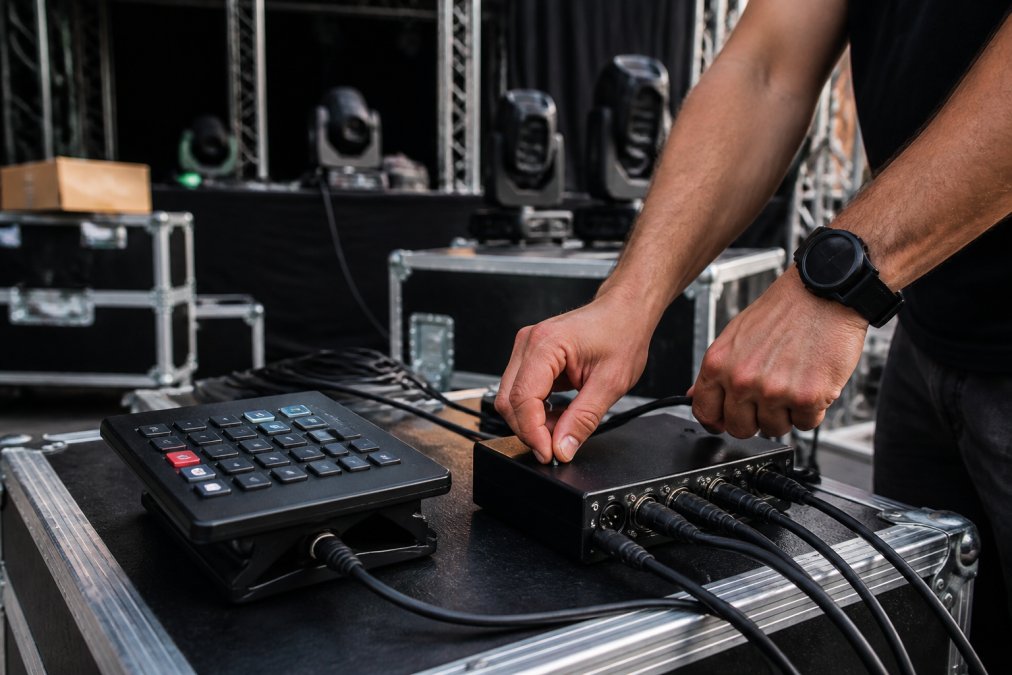
Connect your DMX fixtures using the appropriate output kit for your setup. For venues already running a lighting console, the Pro Dual I/O Kit lets you receive DMX from your console and send DMX to fixtures simultaneously, your console drives the system, and the hub adds smart lights without replacing your existing workflow.
Govee and other smart lights connect via Wi-Fi. The DMXSmartLink software communicates with them over your network, translating your button press into both DMX commands and network commands simultaneously.
Connecting the App: Every Scene Becomes a Key
When you press a button on the Stream Deck, it triggers the corresponding scene in your DMX lighting software.
In the DMXSmartLink Stream Deck app, connect to your hub (plug the deck directly into the hub's USB port, or connect over the network from your Mac or Windows PC using Find hubs or type the IP, then Connect). The app lists your saved scenes, and every one of them is already on a key. No mapping, no profile building required.
The app includes a key-brightness slider, or use the hub's STREAMDECK_BRIGHTNESS setting to control all keys at once, important for visibility during dark shows.
Wi-Fi smart light communication can introduce delay. If you're syncing Govee lights with music-triggered cues, test the timing during rehearsal. A wired network connection for your hub reduces latency significantly.
DMX Lighting Software for Churches and Live Venues
Churches typically run a mix of equipment: a legacy console, LED par cans, and Govee smart lights. A traditional console can't talk to Govee, leaving you with two separate systems.
DMXSmartLink solves this by translating between your console and smart lights. Your existing console remains the master, controlling your DMX fixtures as always. Your volunteers press buttons on a Stream Deck, which recalls scenes that include both your professional fixtures and your smart lights.
For live venues and theaters, the Stream Deck becomes your cueing device. Save your scenes on the hub, and each one becomes a key. During the show, your operator uses the deck for cue recall, leaving the console free for real-time adjustments.

Working with DMX Fixture Profiles and Scene Management
DMX fixture profiles define how your lighting fixtures respond to DMX commands. The DMXSmartLink fixture library includes 12,000+ profiles covering most commercial lighting fixtures.
A scene captures your stage layout, fixture selection, and the full DMX state. When you save a scene, you're saving the exact state of your entire lighting system.
Recalling a scene returns your rig to that exact state. Save your Sunday morning look, 40% intensity on the stage wash, full blue on the cyc, Govee lights at 30% brightness, as a scene. Next week, one button press restores it perfectly.
Save scenes for the welcome, worship, announcements, and altar moment. Your tech volunteer presses buttons in sequence. The lighting follows the flow of the service without manual adjustment.
For touring DJs, scene management means consistency across venues. Save your opening look, warm-up, peak moment, and cool-down. Load into a new venue, plug in the Stream Deck, and your rig behaves identically.
Live Show Lighting Automation: From Setup to Performance
Live show lighting automation begins during load-in. Set up your fixtures, test connections, and build your scene library methodically.
Connect your hub to your console or computer, add your fixtures to the software using their profiles, and assign them to DMX channels. Test each fixture individually to confirm commands are reaching them correctly.
Build your scenes: baseline looks (full stage, house only, blackout, emergency), then show-specific scenes (opening, transitions, special moments, finale). Save each with a clear name.
During rehearsal, practice your button presses. Know where each button is without looking, muscle memory is essential for low-light performance.
On show night, arrive early and run through your scene sequence. Confirm Wi-Fi stability for smart lights and that your Stream Deck is charged.
Troubleshooting Connection Issues and Latency
For USB issues, confirm your Stream Deck is plugged into a powered USB port. On Windows or Mac, quit the Elgato Stream Deck app first if switching between computer and hub connection, the app holds the device and prevents the hub from accessing it.
For network issues, check Wi-Fi signal strength. If weak, move your router closer or use a wired Ethernet connection for your hub. Confirm smart lights are on the same network as your hub.
For DMX signal problems, check your XLR cables for damage or loose connectors. Use a DMX tester to confirm signal flow.
Latency typically comes from Wi-Fi communication to smart lights (50-200 milliseconds depending on your network) (peer-reviewed research). If you're experiencing noticeable lag, move closer to your router, reduce network devices, or use a wired connection for your hub.
Test your setup under real show conditions during dress rehearsal. Venues fill with people, affecting Wi-Fi propagation. Note any timing issues and adjust your button press rhythm accordingly.

Conclusion
Stream Deck DMX lighting control transforms how you manage live events by unifying DMX fixtures and smart lights under a single button interface. Connect your hardware, save your scenes, and perform.
DMXSmartLink handles fixture profiles, scene management, and network communication automatically. You don't need to understand MIDI mapping or DMX protocol, just save your scene and press buttons. Start with the free 14-day trial to see unified lighting control in your venue. For setup help, visit the stream deck setup guide. The DMX Smart Link HUB is the fastest path from setup to reliable, professional lighting automation.
Frequently Asked Questions
Q: Can a Stream Deck control DMX lighting directly?
A: A Stream Deck alone cannot send DMX signals. You need a DMX interface or software that converts button presses into DMX commands. Stream Deck DMX lighting control works by connecting your deck to software or hardware that handles the actual DMX signal transmission to your fixtures. The Stream Deck becomes your tactile command center, triggering scenes and lighting cues that the software or interface then sends out as DMX protocol signals to your lighting rig.
Q: How do I connect a Stream Deck to my lighting rig?
A: Connect your Stream Deck to a computer running DMX control software, or plug it directly into a DMX hub via USB. The software or hub recognizes the deck and maps your button presses to saved lighting scenes. When you press a key, it triggers the scene, and all your DMX fixtures and smart lights respond together. For remote operation, you can also connect the deck to a Mac or Windows PC running the free DMXSmartLink app, which communicates with hubs on your network, ideal when your hub lives in a rack or closet.
Q: What is the easiest way to trigger lighting scenes during a live show?
A: Save your lighting setup as a scene in your DMX software, and every scene appears on a Stream Deck key automatically. One press recalls the entire scene: DMX fixtures and smart lights change together instantly. This eliminates the need to fumble with multiple apps or console faders mid-performance. The scene captures your stage layout, fixture selection, and the full DMX frame, so recalling it returns your rig to exactly the state you saved. For churches and small venues, this means Sunday morning setups happen in seconds, and DJs can switch looks between songs without breaking eye contact with the crowd.
Q: Does DMX lighting software work with smart lights like Govee?
A: Yes, professional DMX software can patch Govee and other smart lights into your lighting console as real DMX fixtures. This means you control them alongside traditional DMX gear from a single interface. You avoid app fumbling mid-show and get a unified dashboard for your entire rig. With 12,000+ fixture profiles available, most common smart lights are already supported, and you can recall scenes that include both your professional fixtures and smart lights with one button press.
This article was written using GrandRanker
