
Table of Contents
- Why Church Rigs Need Different DMX Software Than Other Venues
- What to Look For in Reliable DMX Software for Church Lighting
- Hardware Compatibility Matrix: Matching Software to Your Rig
- Integrating Smart Lights Into DMX Rigs Without Adding Complexity
- DMX Lighting Software for Beginners: Training Volunteers Fast
- Best Practices for Church Lighting Design That Hold Up Sunday After Sunday
- Hardware vs. Software Consoles: What Your Tech Team Actually Needs
- Verdict: Building a Reliable, Volunteer-Friendly Lighting System
- Frequently Asked Questions
Last Updated: September 9, 2026
Why Church Rigs Need Different DMX Software Than Other Venues
A worship service is not a concert tour. Touring DMX software assumes a dedicated programmer behind a console every night, while a church rig runs on rotating volunteers who need the lights to work the moment the first song starts.
Reliable dmx software for church lighting rigs must prioritize predictability over raw feature count. When a volunteer presses "go" during a sermon transition, there is no room for a dropped frame or a confusing interface.
At DMXSmartLink, we build for this exact scenario. Our software treats the rig as a fixed environment where scenes are saved once and recalled reliably. The core question is not "what can this software do," but "can a volunteer run it flawlessly on a Sunday morning."

What to Look For in Reliable DMX Software for Church Lighting
Reliable dmx software for church lighting rigs comes down to four non-negotiable pillars: system stability, a shallow learning curve, hardware compatibility, and predictable scene recall. If any one fails, the software is a liability regardless of its feature list.
System stability means the software does not crash or glitch mid-service. A software-timed USB-to-DMX dongle depends on your computer's processor; if the laptop runs a background update, your lights can flicker or freeze (enttec.com). A hardware-timed interface like the ENTTEC DMX USB Pro buffers the DMX signal internally, so output stays consistent even under heavy CPU load.
The user interface must also be legible to a first-time volunteer. Look for software that saves complete scenes, including the full DMX frame for every universe, so recalling a scene returns the rig to exactly the state you saved.
Hardware Compatibility Matrix: Matching Software to Your Rig
Before choosing software, map what you actually own. A church rig is rarely a clean, single-vendor system, likely a mix of older DMX fixtures, newer LED pars, and budget smart lights.
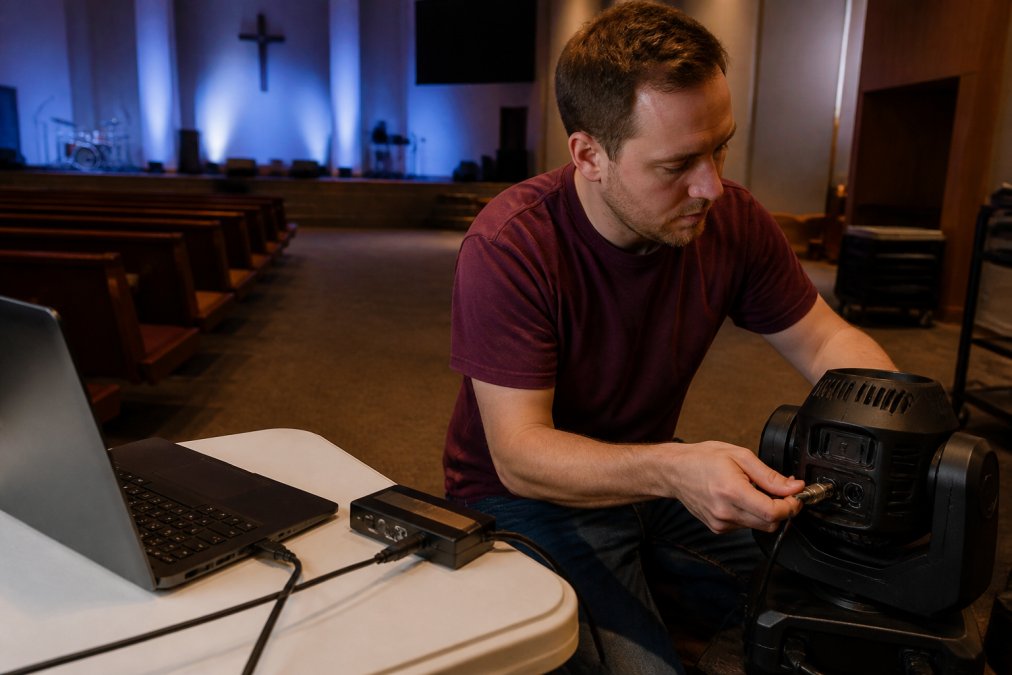
Most professional fixtures accept DMX512 over XLR cables; network-based control uses Art-Net or sACN over Ethernet; smart lights like Govee use Wi-Fi and proprietary protocols. Reliable dmx software for church lighting rigs needs to link these worlds, letting you patch a Govee strip as if it were a standard DMX fixture.
The USB-to-DMX Interface: Your Most Critical Decision
The single most common point of failure in a church DMX setup is the USB-to-DMX interface. This small dongle converts the USB signal from your laptop into the DMX512 data stream your fixtures understand. There are two fundamentally different types, and choosing wrong will cause problems you will chase for months.
Software-timed interfaces (often under $50) rely on your computer's CPU to generate the DMX signal. They work for a hobby setup, but in a live service, a background Windows update or a heavy PowerPoint slide can interrupt the data stream, causing flicker or dropout.
Hardware-timed interfaces (typically $150-$400) contain their own microprocessor that buffers the DMX signal internally. Once you send a scene, the interface holds and outputs that data continuously, independent of your computer's processor load. The Enttec DMX USB Pro, the DMX King eDMX1, and the Chauvet DMX-AN2 are industry standards. For a permanent church install, this is the difference between reliable control and random flickers during a sermon.

A Practical Compatibility Matrix for Common Church Setups
| Rig Component | Connection Type | Recommended Interface / Node | Software Requirement |
|---|---|---|---|
| Legacy DMX fixtures (pars, moving heads) | XLR (3 or 5 pin) | Enttec DMX USB Pro (hardware-timed) | Native USB driver support; no third-party middleware |
| LED pars & moving heads (modern) | DMX512 over XLR | DMX King eDMX1 (hardware-timed) | Multi-universe support (at least 4 universes for mid-size rigs) |
| Govee & smart lights | Wi-Fi / proprietary | None (direct network connection) | Software that patches them as DMX fixtures via local network discovery |
| Network nodes (Art-Net / sACN) | Ethernet (Cat5/6) | Enttec ODE, DMX King eDMX2 | Native Art-Net and sACN protocol support; no separate node software |
| Existing hardware console | DMX or Art-Net | Any of the above, depending on console output | Ability to accept external console input and merge or override |
The Three Compatibility Traps That Break Church Setups
Trap 1: Assuming all USB interfaces are the same. A $30 software-timed dongle will work in a bedroom test, but it will fail under the sustained load of a two-hour service. Always verify the interface is hardware-timed before purchasing.
Trap 2: Ignoring driver and OS compatibility. Some interfaces require proprietary drivers that break after a macOS or Windows update. The most reliable setups use class-compliant USB drivers, working without extra software, so a volunteer's laptop can run them without admin rights.
Trap 3: Buying a multi-universe interface when you only need one. A church with 12 LED pars and 4 moving heads rarely needs more than one DMX universe (512 channels). Buy a single-universe hardware-timed interface and invest the savings in a pre-tested backup unit kept in the tech booth.
Integrating Smart Lights Into DMX Rigs Without Adding Complexity
Many churches are integrating smart lights into DMX rigs, picking up affordable Govee fixtures for accent lighting, foyer washes, or stage edge effects. The challenge is controlling them from the same console as your professional fixtures without resorting to a separate phone app mid-service.
The solution is software that treats smart lights as real DMX fixtures. When a Govee light is patched with a fixture profile, it appears in your channel list just like an LED par. You can include it in cue lists, group it with other fixtures, and save it into scenes.
How Smart Light Integration Actually Works
Smart lights like Govee, Philips Hue, and Nanoleaf do not speak DMX512 (ieee.org). They communicate over Wi-Fi using proprietary protocols, typically via a LAN or cloud-based API. To integrate them into a DMX rig, your software must link two worlds:
- Discovery: The software scans your local network for smart light devices. This usually happens automatically, but some systems require you to enter the device's IP address or use a pairing code.
- Patching: Once discovered, the software assigns a DMX channel range to each smart light. A Govee RGB strip might consume 3 channels (red, green, blue), while a more advanced model with white and color temperature might need 5 or 6.
- Control: The software sends commands over your network (using UDP packets) to the smart light's local API. This happens in real time, alongside the DMX data going to your USB interface.
The Two Most Common Failure Points (And How to Avoid Them)
Failure Point 1: Wi-Fi congestion and latency. Smart lights are only as reliable as your church's Wi-Fi network. If 30 volunteers are on their phones during a service, your Govee lights may respond late or drop out. The fix is a separate, isolated network exclusively for lighting control.
Failure Point 2: Cloud dependency. Some smart light brands route commands through cloud servers, making your lighting control depend on your internet connection (nist.gov). Look for software that communicates with smart lights over your local network only, local control is reliable; cloud control is a liability.
A Step-by-Step Workflow for a Sunday-Ready Smart Light Setup
- Inventory and label: List every smart light you own, its model number, and its physical location.
- Create a dedicated lighting network: Set up a separate Wi-Fi network (or VLAN) for all smart lights and your control computer.
- Patch in the software: In your DMX software, add each smart light as a fixture. Assign a logical DMX address range.
- Build scenes with both fixture types: Create a scene that includes your professional LED pars and your Govee strip in the same cue. Test it repeatedly.
- Test under load: Run a full rehearsal with the same Wi-Fi conditions as a live service. If you see latency, move the control computer closer to the access point.
This approach requires the software to handle multiple protocols simultaneously, Art-Net or sACN to network nodes, USB-to-DMX for physical fixtures, and smart lights over your local network, all from one unified dashboard.
DMX Lighting Software for Beginners: Training Volunteers Fast
The volunteer turnover rate in most churches means DMX lighting software for beginners must be learnable in a single training session. The most reliable dmx software for church lighting rigs is the one a new operator can run after one walkthrough.
The key is scene-based operation. Instead of teaching volunteers to program from scratch, you program the show once and save it. The volunteer's job becomes selecting the correct scene at the correct time.
A practical training approach has three steps. First, walk the volunteer through the saved scenes, explaining what each is for. Second, show them how to recall a scene and what to do if something looks wrong, usually a simple reset. Third, let them run a full rehearsal with you watching.
Best Practices for Church Lighting Design That Hold Up Sunday After Sunday
Best practices for church lighting design are less about artistic flair and more about consistency and reliability. The goal is an environment that supports worship without drawing attention to itself.
Start by building a small library of reliable scenes that cover the typical service flow, testing them repeatedly during rehearsal. Store these scenes on a system that recalls them instantly, and back up the show file.
Consistency also comes from standardizing your rig. When you add fixtures, keep the patching documentation updated and label every DMX cable and channel in the software.
Hardware vs. Software Consoles: What Your Tech Team Actually Needs
The debate between hardware consoles and software-based control misses the point for most churches. A traditional hardware console is expensive and has its own learning curve. A software-based console is often more flexible and affordable, but it must be reliable.
For a church environment, the ideal is often a hybrid approach. Use the software you already know for programming, and consider a dedicated hardware appliance that runs the software so you are not dependent on a volunteer's personal laptop.
The real question is not hardware versus software, but how you eliminate single points of failure. A dedicated appliance with a pre-installed license is more reliable than a laptop that might update overnight.
Verdict: Building a Reliable, Volunteer-Friendly Lighting System
Building a reliable lighting system for a church is an exercise in restraint. You need the most dependable software your team can actually operate.
The most reliable dmx software for church lighting rigs will handle your legacy DMX fixtures, network nodes, and smart lights from one interface. It will save scenes that anyone can recall and run on hardware you do not have to fight with.
We built DMXSmartLink for this reality. Our software patches Govee and smart lights as real DMX fixtures, works alongside platforms you may already use over Art-Net and sACN, and runs on a Mac, Windows PC, Raspberry Pi, or a pre-configured HUB. A free 14-day trial with no credit card required lets your team test it before committing.

Frequently Asked Questions
What is the best lighting software for churches?
The best church lighting software balances reliability with a short learning curve for volunteers. Look for software that stores complete scenes so a volunteer presses one named button instead of rebuilding cues. DMX Smart Link runs on a Mac, Windows PC, or a dedicated HUB and recalls the full DMX frame per universe. A 14-day free trial lets your team test it before committing.
Will DMX software work with both my older DMX fixtures and Govee smart lights?
Yes, when you use software that connects both protocols. DMX Smart Link patches Govee lights as real DMX fixtures alongside traditional pars and moving heads. It speaks Art-Net and sACN, so it works with consoles like QLC+ and Lightkey. For physical DMX output, choose a kit with a USB-to-DMX interface like the ENTTEC DMX USB Pro.
How much training does a volunteer need to run church DMX software?
The goal is training measured in minutes, not weeks. Software that saves complete scenes means a volunteer selects a saved scene for the sermon or worship set and presses go. DMX Smart Link's scene recall works from a web dashboard. This removes the need to understand channel mapping or patching during a live service.
What happens if my DMX software crashes during a live service?
System stability starts with hardware-timed output. A buffered interface like the ENTTEC DMX USB Pro generates a steady DMX stream independent of your computer's processor load. For added resilience, a dedicated HUB appliance runs the software without other tasks competing for resources. Test your full rig during the week to confirm behavior before Sunday.
Reliable lighting is not about the most impressive feature set; it is about a system your volunteers can run with confidence. DMXSmartLink delivers a unified dashboard for your entire rig, eliminating app fumbling and providing stable, low-latency control for live events. Get started with DMXSmartLink and build a lighting system your team can trust every single week.
