
Table of Contents
- QLC+ vs SoundSwitch: Quick Comparison Table
- QLC+ MIDI Mapping for DJs: Flexibility and Control
- SoundSwitch Subscription Pricing: What You Actually Pay
- Integrating Smart Lights into DJ Rigs: Where Both Tools Fall Short
- Real-Time Performance: Latency, Sync, and Live Reliability
- Mobile DJ vs Club Installation: Which Use Case Fits Each Tool
- Which Should You Pick? A Decision Framework
- Frequently Asked Questions
Last Updated: September 10, 2026
QLC+ vs SoundSwitch: Quick Comparison Table
Choosing between QLC+ and SoundSwitch for DJ lighting control, the qlc+ vs soundswitch decision, comes down to one question: do you want a free, infinitely customizable open-source platform, or a polished subscription tool built specifically for DJs? This guide from DMXSmartLink breaks down both options so you can pick the right fit for your rig.

QLC+ is a free, open-source DMX lighting controller that runs on Mac, Windows, and Linux, offering deep customization through a virtual console, cue lists, and MIDI mapping. SoundSwitch is a paid subscription platform built for DJs that syncs lighting to music libraries with minimal setup. Neither handles smart lights natively, which is where most DJ rigs hit a wall.
| Feature | QLC+ | SoundSwitch |
|---|---|---|
| Cost | Free, open-source | Subscription-based |
| Platform | Mac, Windows, Linux | Windows only |
| Setup difficulty | Moderate to steep | Beginner-friendly |
| MIDI mapping | Full, manual | Limited, preset-focused |
| Smart light support | None natively | None natively |
| Best for | Tinkerers, fixed installs | Mobile DJs wanting speed |
QLC+ official documentation on DMX universes and patching
The table above tells the headline story, but the real differences show up in workflow, latency, and how each tool handles the smart lights increasingly common in DJ setups.
QLC+ MIDI Mapping for DJs: Flexibility and Control
QLC+ MIDI mapping is where the platform earns its reputation among technically minded DJs. You can assign any fader, button, or knob on your controller to any lighting parameter, build a virtual console that mirrors your hardware, and trigger scenes or chases from the same surface you use for audio.
The trade-off is time. Mapping a full show in QLC+ typically takes an afternoon of patching fixtures, defining scenes, and assigning MIDI notes. Novices often underestimate this. A common mistake is mapping every fixture individually instead of grouping them, which makes the virtual console unusable during a live set.
What most guides miss is that QLC+ rewards planning. Sketch your fixture groups first, decide which parameters need live control versus preset recall, then map. DJs who skip that step end up with a cluttered console and fumble mid-show.
SoundSwitch Subscription Pricing: What You Actually Pay
SoundSwitch subscription pricing follows a recurring model rather than a one-time purchase, which matters if you run events year-round. The platform bundles its lighting engine with music library analysis, so the value proposition is speed: load a track, and SoundSwitch generates a synced light show automatically.
For DJs who perform several times a week, that automation saves real hours. For occasional performers, the recurring cost adds up against a tool you may only open monthly. That is the honest trade-off, and it is why many DJs eventually look at combining a free controller with a smart-light link instead.
The bigger issue is lock-in. When your show lives inside a subscription tool, you lose flexibility the moment you stop paying. Open-source alternatives keep working forever, even if they demand more setup upfront.
Integrating Smart Lights into DJ Rigs: Where Both Tools Fall Short
Integrating smart lights into DJ rigs exposes the biggest gap in both platforms. QLC+ and SoundSwitch were designed around traditional DMX fixtures, not the Govee and Matter smart lights that increasingly fill mobile setups. Neither patches a smart bulb as a native DMX fixture out of the box.
That gap is exactly what DMXSmartLink solves. DMXSmartLink patches Govee and smart lights into your lighting console as real DMX fixtures, so your existing QLC+ show file or SoundSwitch workflow can drive them alongside your par cans and moving heads. It supports Art-Net and sACN, runs on Mac, PC, Pi, or Linux, and works with the console software you already use.
Real-Time Performance: Latency, Sync, and Live Reliability
Latency is the metric that separates a rig that feels alive from one that feels laggy, and it is the one topic almost no comparison article actually quantifies. Here is the mechanism behind the numbers, so you can reason about your own rig instead of trusting forum anecdotes.
Where latency comes from. In any DJ lighting chain there are four contributors: (1) the software's internal frame scheduler, (2) the transport from software to interface (USB, Art-Net, or sACN over Ethernet), (3) the interface's own processing and refresh rate, and (4) the fixture's DMX decode time. QLC+ runs a scheduler that emits DMX frames at a configurable rate; the default is 50 Hz (a 20 ms frame interval), and you can raise it in the I/O settings. SoundSwitch drives its output from its analyzed track timeline, so its effective timing is tied to the audio playback clock rather than a free-running frame timer.
What that means in practice. A 50 Hz output rate gives you a 20 ms floor before transport and interface overhead. On a wired USB-DMX interface, total end-to-end latency typically lands in the 20-40 ms range on a healthy machine (usitt.org). Over Wi-Fi Art-Net, jitter, not average latency, is the killer: a 5 ms average with 30 ms spikes reads as visible stutter on fast chases even though the average looks fine. Wired Ethernet Art-Net or sACN removes most of that jitter class. This is why touring LDs run copper, not Wi-Fi, for show-critical universes.
SoundSwitch's timing model. Because SoundSwitch syncs effects to its own analyzed tracks, beat-matched chases stay tight without manual nudging, the software already knows where the downbeats are. The trade-off is that everything depends on the software staying stable and the audio clock staying clean. If the app stalls or the audio buffer glitches, the lights glitch with it. There is no separate hardware clock to fall back on.
QLC+'s timing model. QLC+ gives you manual control over frame rate and lets you run a hardware-timed interface, which removes a whole class of flicker and dropout problems that generic USB dongles introduce. The cost is that you own the timing, you decide the frame rate, you decide the transport, and you tune it against your fixture count. Driving four universes at 50 Hz on a Raspberry Pi is a different workload than driving one universe on a laptop, and QLC+ will let you overcommit if you are not paying attention.
A reliability checklist that actually maps to the failure modes.
- Set your QLC+ output frame rate deliberately (50 Hz is a safe default; drop to 30 Hz if CPU load is high, raise only if your fixtures and interface support it).
- Prefer wired Art-Net or sACN over Wi-Fi for any universe driving fast movement or strobe.
- Use a hardware-timed interface rather than a generic USB dongle for show-critical universes.
- Keep a second interface and a saved show file on a USB stick, this is the redundancy that matters when something fails at load-in.
- Test the full chain (software → transport → interface → fixture) before doors, not during soundcheck.
Mobile DJ vs Club Installation: Which Use Case Fits Each Tool
The mobile-vs-install split is where most comparisons stop at a slogan: SoundSwitch for mobile, QLC+ for installs. That is true as far as it goes, but the real differences show up in the workflow, the hardware, and the failure modes of each environment. Here is the concrete version.
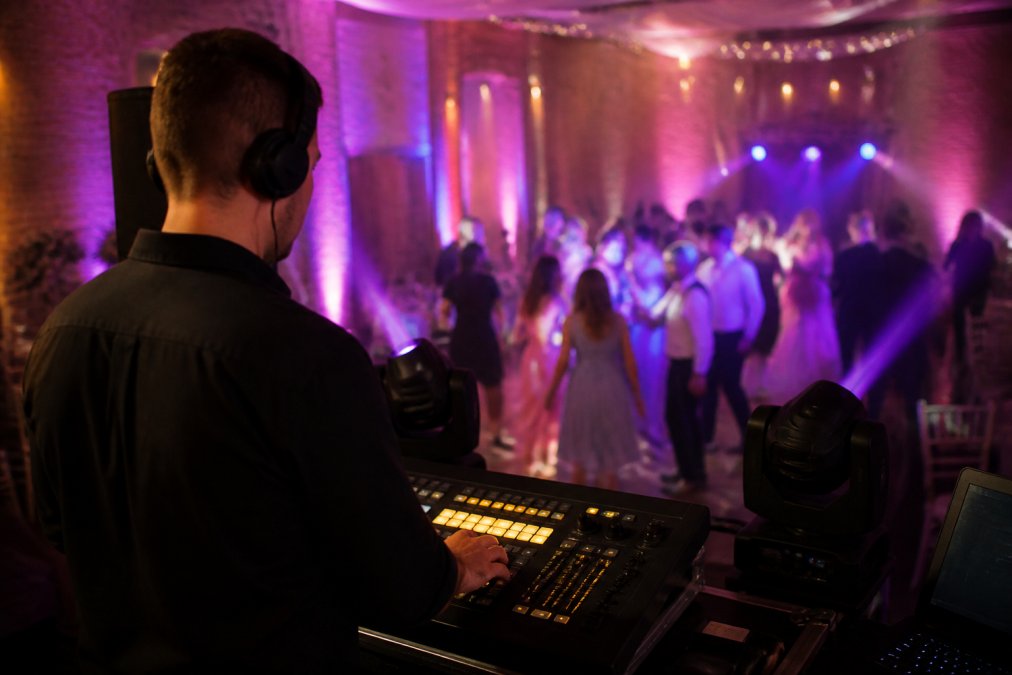
Mobile DJ workflow. A mobile rig is torn down and rebuilt every gig, often in a room you have never seen, with limited setup time and no guarantee of clean power or a wired network. SoundSwitch fits this because the show is generated from the music library: you load a track, the software produces a synced light show, and you are running. There is no patching session between gigs, no virtual console to rebuild, and no show file to reconcile against a different fixture inventory. The cost is flexibility, you are working inside the software's automation model, and deep custom looks require fighting that model.
Club and installation workflow. A fixed rig is programmed once and then runs for months. The priorities invert: reproducibility, remote management, and the ability to version and back up show files matter more than setup speed. QLC+ fits this because it runs headless on a Raspberry Pi, can be scripted, and costs nothing to deploy across multiple rooms. Technical directors at venues and churches often standardize on QLC+ precisely because they can put a show file under version control, roll it back if a change breaks, and run the same cues from a Pi in a rack with no operator at the console.
The hardware reality of each. Mobile rigs lean on compact USB-DMX interfaces and increasingly on wireless DMX or Art-Net over a travel router. Installations lean on wired Ethernet, sACN or Art-Net, and often a dedicated show network isolated from the venue's general traffic. The transport choice is not cosmetic, it determines whether your show survives a crowded 2.4 GHz band at a wedding.
Where the two worlds collide. DJs who work both, a weekly club residency plus private events, hit the real problem: the show file does not travel cleanly between environments. A QLC+ virtual console built for a fixed rig does not map one-to-one onto a mobile setup with different fixtures, and a SoundSwitch show generated for one library does not adapt to a venue rig with moving heads it was never told about.
The hardware-agnostic answer. The practical fix is to standardize on a transport that both environments speak, Art-Net or sACN, and keep your cues at the protocol layer rather than inside one piece of software. That way the same cues drive different rigs without reprogramming, and your show file is portable between a Pi in a rack and a laptop at a gig. This is the angle most comparisons miss: the question is not which software wins, it is which transport keeps your show portable across both use cases.
If your work spans both worlds, the practical answer is a controller that speaks Art-Net and sACN so your show file travels with you. Hardware-agnostic setups mean the same cues drive different rigs without reprogramming.
Which Should You Pick? A Decision Framework
Pick QLC+ if you want zero cost, full control, and you are comfortable spending an afternoon mapping MIDI and building a virtual console. Pick SoundSwitch if you are a mobile DJ who values fast setup and automated sync over deep customization, and the subscription fits your booking volume.
Here is a simple framework:
- Choose QLC+ if your rig is fixed, you run Linux or a Pi, or you want to avoid recurring fees.
- Choose SoundSwitch if you play multiple gigs weekly and want lights synced with minimal programming.
- Choose neither alone if your setup includes Govee or smart lights, because both platforms need a link to control them as DMX fixtures.
Art-Net protocol specification from Artistic Licence
For DJs integrating smart lights, DMXSmartLink fills that link role: it patches smart lights as real DMX fixtures and works alongside QLC+, Lightkey, and grandMA over Art-Net and sACN. A free 14-day trial lets you test it against your actual rig before committing.
Most DJs eventually hit the same wall: their controller software handles traditional fixtures well, but their smart lights sit outside the show entirely, forcing awkward app switching mid-set. DMXSmartLink closes that gap by patching Govee and smart lights into your console as real DMX fixtures, with Art-Net and sACN support, cross-platform compatibility on Mac, PC, Pi, or Linux, and a unified dashboard that keeps your entire rig under one interface. Start the free 14-day trial with no credit card required and see how your QLC+ or SoundSwitch workflow handles a fully integrated rig.
Frequently Asked Questions
Does SoundSwitch require a monthly subscription?
SoundSwitch uses an annual subscription model. Pricing varies by plan tier and whether you bundle it with other products. The subscription covers software updates and ongoing development. If you stop paying, the software stops working. QLC+ takes a different approach: it is free and open-source, so you never pay a subscription, but you handle your own setup, troubleshooting, and fixture profile creation. Your choice depends on whether you prefer predictable ongoing costs or upfront time investment.
Can QLC+ be used for live automated DJ lighting?
QLC+ handles live automated lighting through its virtual console and cue list features. You build scenes, chases, and effects, then trigger them via MIDI controllers or keyboard shortcuts. The catch is that QLC+ does not analyze audio or beat-match automatically the way SoundSwitch does. You either trigger cues manually or set up your own audio-reactive workflows. For DJs who want lights that follow the music without manual triggering, QLC+ requires significant configuration work.
Is QLC+ difficult to learn for beginners?
QLC+ has a steeper learning curve than most commercial DJ lighting tools. The interface exposes DMX universes, fixture patching, channel mapping, and scene programming at a low level. If you understand DMX fundamentals, you can get running in a few hours. If you have never patched a fixture or built a cue list, expect a weekend of tutorials before your first show. SoundSwitch is easier to start with because it automates more of the setup process.
What DJ software does SoundSwitch work with?
SoundSwitch integrates directly with Serato DJ and Virtual DJ through official partnerships. It reads track metadata and beat grids from those platforms to generate automatic light shows in real time. If you use rekordbox, Traktor, or other DJ software, SoundSwitch does not offer the same native integration. QLC+ works independently of your DJ software since it relies on MIDI, OSC, or Art-Net input rather than reading your music library directly.
How do I integrate smart lights like Govee into a DJ rig with QLC+ or SoundSwitch?
Neither QLC+ nor SoundSwitch natively controls Govee or other consumer smart lights over Wi-Fi. QLC+ speaks DMX and Art-Net, while SoundSwitch outputs DMX through supported hardware interfaces. To link smart lights into your rig, you need a tool that translates DMX or Art-Net into the smart light platform's protocol. DMXSmartLink handles this by patching Govee lights as DMX fixtures, so they appear in your console alongside traditional fixtures. It runs on Mac, Windows, or Raspberry Pi and supports Art-Net and sACN.
