
Table of Contents
- Why Connect Govee Lights to DMX?
- Prerequisites: Hardware and Software for DMX Control
- Step 1: Choose Your Link Hardware
- Step 2: Configure the Network and IP Address
- Step 3: DMX Pixel Mapping for LED Installations
- Step 4: Integrating Govee with Lightkey or QLC+
- Troubleshooting Common Connectivity and Latency Issues
- Build a Reliable Setup for Live Events
- Frequently Asked Questions
Last Updated: September 6, 2026
Connecting Govee lights to DMX means translating standard DMX512 control data into commands Govee's Wi-Fi and Bluetooth hardware can understand, letting a professional lighting console control consumer smart lights as standard fixtures. Since Govee products do not natively speak DMX, you need a software or hardware link. This DMXSmartLink guide covers the hardware, network configuration, and software setup to bring your smart lights into a unified production rig.
The most important insight is that a dedicated interface can eliminate some reliability issues of Wi-Fi-only solutions during live events. Professional use often benefits from a hardware node that can buffer and time the DMX signal correctly.
Why Connect Govee Lights to DMX?
Connecting Govee lights to DMX eliminates fumbling with a phone app during a live show. A lighting console controlling every fixture lets you program scenes, trigger cues, and synchronize effects across professional fixtures and smart LED strips from one interface.
For mobile DJs, church tech teams, and small theaters, the cost benefit is significant: Govee products cost a fraction of professional RGB fixtures yet deliver impressive wash and accent lighting. The trade-off has always been control, since consumer apps are not built for cue stacks or beat-synced programming.
DMX pixel mapping for LED installations also becomes possible when you link this gap. Instead of treating a Govee strip as a single color zone, proper integration lets you address individual segments or pixels, opening up effects like chases, sweeps, and audio-reactive patterns that follow your console's master timing.
Prerequisites: Hardware and Software for DMX Control
You need three core components: a Govee light with LAN control support (typically Wi-Fi models, not Bluetooth-only), a interface that translates DMX to Govee's network protocol, and lighting software on a computer.
Your computer must be on the same local network as the Govee lights and link. A dedicated router or switch for your lighting rig is strongly recommended, since venue Wi-Fi is often congested and unreliable for time-sensitive control data.
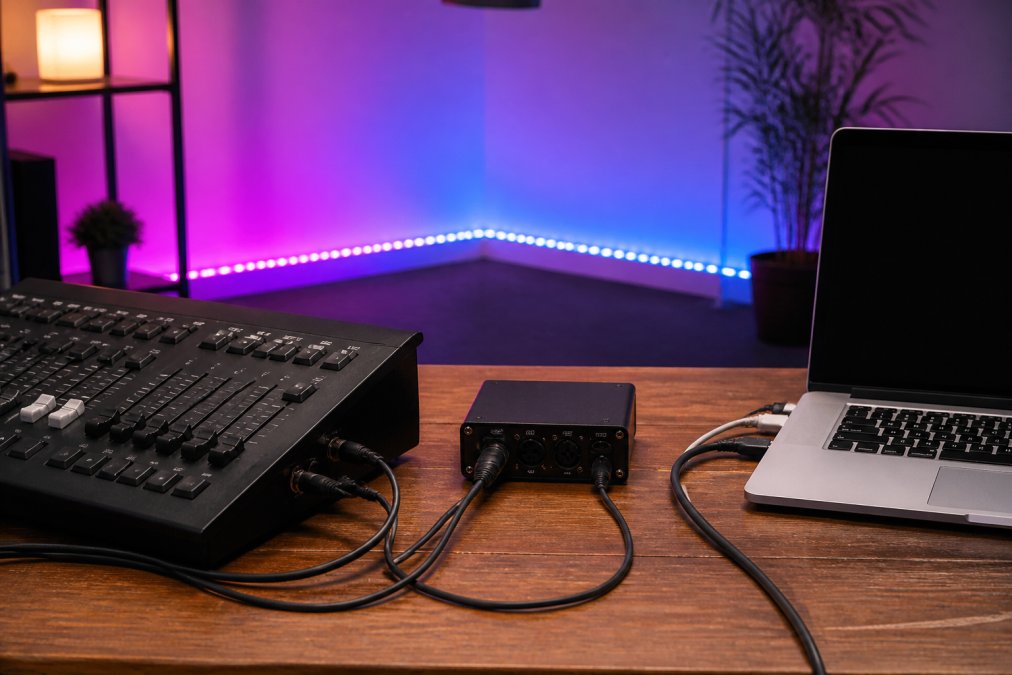
The software side requires a lighting application supporting Art-Net or sACN output, such as Lightkey, QLC+, or grandMA. In smaller setups, the link itself may eliminate the need for a separate hardware DMX interface.
Step 1: Choose Your Link Hardware
The link is the most critical decision. A simple Wi-Fi link converting Art-Net to Govee commands works for static scenes but introduces latency and packet loss risks unacceptable for live performance. A dedicated hardware node with wired Ethernet provides the needed stability.
The DMXSmartLink HUB family is designed for exactly this purpose. The DMX Smart Link HUB - Network Edition at $299.00 handles the Art-Net and sACN translation for Govee and other smart lights, and it also captures scene states so you can recall an entire rig layout with one press. For setups that also need to drive standard DMX fixtures, the Output Kit adds a USB-to-DMX interface for $349.00, allowing you to plug directly into conventional fixtures with an XLR cable.

For permanent installations in venues or houses of worship, the Pro Output Kit at $449.00 includes a hardware-timed USB-DMX interface that prevents flicker on demanding fixtures. The most flexible option is the Pro Dual I/O Kit at $649.00, which supports simultaneous DMX input and output, letting you take a live feed from an existing console and blend in your smart lights.

| Hub Model | Price | Best For | Key Capability |
|---|---|---|---|
| Network Edition | $299.00 | First-time DMX users | Art-Net/sACN translation, scene recall |
| Output Kit | $349.00 | Small rigs with DMX fixtures | Adds USB-to-DMX output |
| Pro Output Kit | $449.00 | Venues and permanent installs | Hardware-timed, flicker-free DMX |
| Pro Dual I/O Kit | $649.00 | Complex productions | Simultaneous DMX input and output |
Hardware-Only vs. Software-Only Conversion: A Critical Distinction
Most guides focus on software connects running on a laptop, but that can make the computer a single point of failure. If the OS updates mid-show or the CPU spikes, your lights may go dark. A hardware-only converter offloads translation to a dedicated microcontroller that does nothing else.
Practitioners commonly use a dedicated hardware node like the DMXSmartLink HUB or an Enttec DMX-to-Wi-Fi gateway. These receive Art-Net or sACN over Ethernet and translate it to the Govee LAN protocol without a general-purpose computer, providing deterministic timing: the node buffers and retransmits each DMX frame on a fixed interval.
Software-only solutions share CPU time with the OS and other applications, introducing jitter, variance in timing between successive DMX frames. A hardware node can deliver a steady frame rate, while a software link might deliver a variable one. This is invisible for static scenes but can become obvious as stutter or flicker for chases, strobes, or audio-reactive effects.
Latency Benchmarking: What the Numbers Mean
Latency is the time between when the console sends a command and when the light changes state. A hardware node on a wired network can deliver low latency; a software link on Wi-Fi can range higher, depending on network congestion and CPU load.
Before any live show, send a square-wave test pattern, alternating full brightness and zero every 500 milliseconds, and measure the light's response with a high-speed camera or oscilloscope connected to a photodiode. Anything under 50 milliseconds is generally imperceptible; above 100 milliseconds, lag can become noticeable when synchronized to music or other fixtures (peer-reviewed research).
In a hybrid setup, some fixtures on wired DMX and Govee lights on the network, latency differences can cause visible desynchronization. A hardware link that buffers and aligns network output to the DMX frame rate can mitigate this. The DMXSmartLink HUB captures the incoming Art-Net frame and holds it until the next DMX refresh cycle, so Govee lights can respond in the same frame as wired fixtures.
Multi-Device Synchronization Within a Single Universe
A single DMX universe carries 512 channels, and each Govee strip or panel consumes a block. The link assigns each device a starting address, and the console treats them as separate fixtures. Hardware nodes can excel here: they can maintain a single clock for all connected devices, so every strip can receive commands at the same instant.
A software link polling each Govee device sequentially can introduce a stagger effect, the first strip updates, then the second, creating a visible wave. A hardware node broadcasts translated commands to all devices simultaneously over LAN, helping to keep them in lockstep. For a stage wash, this can be the difference between a professional look and a noticeable ripple.
Step 2: Configure the Network and IP Address
Once your link is connected, configure the network so your lighting software can find it. Assign static IP addresses to your computer and link on the same subnet, typically 192.168.1.x, to prevent devices from dropping off when the router reassigns addresses.
In your lighting software, navigate to the Art-Net or sACN settings and specify which universe to transmit and which IP address to send it to. Most applications auto-discover Art-Net nodes, but manual configuration is more reliable for production.
Govee lights communicate over UDP, not TCP. The link handles translation from the Art-Net UDP stream to Govee's proprietary protocol, so no port mapping is needed. Keep the Govee app closed during the show, as it can compete with the link for control.
Step 3: DMX Pixel Mapping for LED Installations
DMX pixel mapping assigns sections of a Govee strip to specific DMX channels so the console can control them individually. Each RGB pixel requires three channels: red, green, and blue.
In your lighting software, define a fixture profile for the Govee strip, telling the software how many pixels it has and how they map to DMX channels. A 5-meter strip with 60 LEDs per meter has 300 LEDs, requiring 900 DMX channels, nearly two full universes (usitt.org).
In practice, group LEDs into segments. Many Govee products expose a fixed number of addressable segments over LAN, and the link maps each to three DMX channels, reducing channel count while still allowing chases and sweeps. Test with a single color before programming complex effects.
Step 4: Integrating Govee with Lightkey or QLC+
Integrating Govee with Lightkey or QLC+ follows the same workflow. After configuring Art-Net output, add the link as a fixture and patch the Govee segments to desired DMX channels. The software sends the full DMX frame over the network, and the link translates it for the Govee hardware.
In Lightkey, create a new fixture profile and select Art-Net as the output protocol. In QLC+, define a custom fixture and assign it to the configured universe. Both support real-time control, so test the patch by moving a fader or triggering a scene.
A link like the DMXSmartLink HUB presents Govee lights as standard Art-Net devices to any console or software, so the same configuration works across Lightkey, QLC+, grandMA, or any Art-Net platform, you are not locked into one ecosystem.
Troubleshooting Common Connectivity and Latency Issues
The most common connectivity issue is the computer and link not being on the same subnet. Verify IP addresses and confirm they can ping each other. If the link is on Ethernet and the computer on Wi-Fi, moving the computer to a wired connection can be beneficial, since Wi-Fi can introduce unpredictable latency.
Latency benchmarking is essential before a live show. Send a test pattern and measure the time between triggering a cue and seeing the light respond. Under 50 milliseconds is generally imperceptible; delays above 100 milliseconds can indicate network congestion or a wireless link buffering packets.
Firmware compatibility is another issue. Govee updates can change the LAN protocol; if lights stop responding after an update, check whether the link vendor has released a corresponding firmware patch.
Build a Reliable Setup for Live Events
A reliable live setup depends on reducing failure points. A dependable configuration is wired: console to switch, switch to link, and link to lights. Every wireless hop can add latency and interference risk, which is why hardware-only translation is often preferred over a software link.
Multi-device synchronization becomes critical when running several Govee products. Because each link translates the same Art-Net frame, all connected lights can stay in sync with each other and with conventional DMX fixtures. This is why a dedicated link can be a valuable investment over a software solution sharing CPU time.
Network Architecture for a Lighting Rig
The recommended topology is a dedicated lighting network, physically separate from guest Wi-Fi and office LAN. A managed switch with VLAN support segments traffic without a second set of cables. Assign the lighting VLAN a static subnet, such as 10.10.10.0/24, and reserve IP ranges for the console, link, and other fixtures.
Art-Net is unauthenticated, so any device on the same subnet could potentially hijack your lights (art-net.org.uk). A mitigation is Layer 2 isolation: enable port isolation or private VLAN mode so only the console and link can communicate, helping to prevent unsolicited Art-Net packets.
If Wi-Fi is necessary, use a dedicated access point on 5 GHz with WPA2 or WPA3 encryption, not shared with audience devices. A common pattern is a small travel router as an isolated network, with the console and link connected via Ethernet to its LAN ports.
Security Hardening for LAN Control
Enabling LAN control on Govee lights exposes them to any device on the local network. The Govee LAN protocol requires no authentication, so any host reaching the device's UDP port can send commands. This is acceptable on an isolated lighting network but dangerous on a shared one.
Before a show, take these steps to harden the setup:
- Disable the Govee app's cloud access on the lights themselves. If the device supports a local-only mode, enable it. This prevents the vendor's cloud servers from sending firmware updates or control commands that could interrupt your DMX stream.
- Set a static IP for each Govee device and the link. DHCP leases can expire mid-show, causing the link to lose track of the lights. Static assignments eliminate this failure mode.
- Block outbound internet access for the lighting VLAN at the router. The link and the lights do not need internet connectivity during a performance. This also prevents any potential remote exploit from reaching the devices.
- Turn off UPnP on the router. Universal Plug and Play can inadvertently open ports on the firewall, exposing the lighting network to the internet.
Redundancy Planning
A single link is a single point of failure. For high-stakes events, running a second link as a hot standby with the same universe mapping and IP settings, powered off until needed, can be a good strategy. If the primary fails, powering on the standby and repointing the console's Art-Net output to its IP can help avoid a dead show.
Carry a spare Ethernet cable and a small unmanaged switch for the console-to-switch link. The most common failure in a portable rig is a damaged cable or loose connector; a $20 switch and a 10-foot cable can help save a performance.
Testing Before the Show
A full-system test should happen at least two hours before doors open. Run through the following checklist:
- Send a test pattern from the console and verify every Govee device responds within 50 milliseconds.
- Trigger a chase sequence across all fixtures and confirm there is no visible stagger between the wired DMX fixtures and the network-connected Govee lights.
- Walk the venue with a wireless DMX analyzer or a simple Wi-Fi scanner to check for interference on the 2.4 GHz band, which Govee devices use. If the band is crowded, move the Govee devices to a less congested channel via the link's configuration interface.
- Cycle power on the link and confirm the lights return to their last state or a blackout state, depending on your preference. This verifies that the link's scene recall works as expected.
Frequently Asked Questions
How to connect lights to DMX controller?
To connect lights to a DMX controller, you need a link that translates between the controller's protocol and the light's native protocol. For Govee lights, this means using a hardware link like the DMX Smart Link HUB. The HUB receives the DMX signal from your console or software via Art-Net, converts it, and sends it over Wi-Fi to your Govee lights. This process patches your Govee fixtures into your console as standard DMX channels, allowing for direct control without the Govee app.
Can you control consumer smart lights with a professional DMX console?
Yes, you can control consumer smart lights like Govee with a professional DMX console. The key is a control software that translates the DMX protocol to the smart light's Wi-Fi protocol. A hardware link, such as the DMX Smart Link HUB, receives Art-Net from your console and sends control signals to the Govee lights. This setup allows you to patch Govee fixtures directly into your console, enabling scene control, pixel mapping, and synchronization with your existing DMX rig.
What hardware or software is needed to link Govee lights to DMX?
You need a hardware link, a computer or console running DMX software, and a network connection. The DMX Smart Link HUB is the central piece of hardware; it connects to your network and communicates with your Govee lights. Your lighting software, such as Lightkey, QLC+, or grandMA, sends Art-Net data over the network to the HUB. For most users, the HUB - Output Kit, which includes a USB-to-DMX interface for standard fixtures, is the recommended starting point.
