
Table of Contents
- Why QLC+ Can't Talk to Govee Lights Directly
- What You Need: Hardware and Software Requirements
- Step 1: Install DMXSmartLink and Connect Your Network
- Step 2: QLC Plus Art-Net Configuration
- Step 3: Patch Govee Lights as DMX Fixtures in QLC+
- Controlling WiFi LED Strips with DMX Console
- DMX Pixel Mapping for LED Installations
- Troubleshooting Common Connectivity Issues
- Frequently Asked Questions
Last Updated: September 9, 2026
Controlling govee lights qlc+ requires connecting Govee's proprietary WiFi protocol to QLC+'s DMX512 or Art-Net output. This guide from DMXSmartLink walks you through the hardware and software link required to make that translation happen.

The core problem is protocol translation: a software layer must receive Art-Net from QLC+, translate the channel mapping into Govee's API commands, and push the payload over your local network. Once that link is in place, your Govee lights behave like any other patched DMX fixture.
Why QLC+ Can't Talk to Govee Lights Directly
QLC+ outputs DMX512 over USB or Art-Net and sACN over your network. Govee lights listen only for commands from the Govee Home app or the proprietary LAN API. There is no native output plugin in QLC+ that speaks Govee's dialect.
The missing piece is a translation service on your network that listens for QLC+'s Art-Net UDP packets, reads the RGB values, and reformats them into API calls Govee's firmware understands. This translation must happen at the network level, not inside QLC+; a fixture definition alone cannot fix this.
What You Need: Hardware and Software Requirements
The minimum viable setup is a computer running QLC+, a network, and a translation service. The difference between a rig that works at rehearsal and one that survives a live show comes down to network structure.
The Computer
Any machine running QLC+ 4.12 or newer works. A Windows laptop, Mac, or Raspberry Pi 4 all handle Art-Net output, since QLC+ only generates UDP packets. For a permanent install, a dedicated mini PC or Pi next to your network switch is most reliable.
The Network Topology
Art-Net is a broadcast protocol by default, so every device on the subnet sees the traffic. This is fine for a small rig but creates broadcast storms and security exposure if your lighting network touches your office LAN.
The cleanest approach is a dedicated lighting subnet. Use a managed switch with VLAN support and create a separate VLAN for lighting traffic. Assign your console computer and each Govee controller a static IP in the 10.10.0.0/24 range to isolate Art-Net broadcasts and prevent DHCP conflicts.
If you cannot VLAN, use a separate physical switch for your computer, the interface, and your Govee controllers, leaving your internet router on a different port.
The Translation Service
DMXSmartLink is one option, but the translation problem can be solved with any software that listens on UDP port 6454 (the Art-Net port) and speaks Govee's proprietary JSON API over TCP or UDP on port 4001 or 4003.
A common open-source pattern is a Python script using the artnet and requests libraries, which subscribes to an Art-Net universe, parses DMX channel values, and maps them to Govee's {"cmd": "colorwc", "data": {"color": {"r": 255, "g": 0, "b": 0}}} payload format, giving you full control over channel mapping and features like gamma correction.
For users who prefer a visual interface, DMXSmartLink patches Govee devices as real DMX fixtures and handles translation automatically. It runs on Mac, Windows, Pi, and Linux, supports Art-Net and sACN, and offers a free 14-day trial.
IP Address Planning
Write down every device's IP address before you start. A typical static assignment looks like this:
| Device | IP Address | Purpose |
|---|---|---|
| QLC+ computer | 10.10.0.10 | Sends Art-Net on universe 1 |
| Control Software host | 10.10.0.20 | Receives Art-Net, sends Govee API |
| Govee strip (left) | 10.10.0.101 | Receives API commands |
| Govee strip (right) | 10.10.0.102 | Receives API commands |
If your Govee controllers only support DHCP, configure your router to assign static leases based on their MAC addresses to prevent IP changes after a power cycle.
The Govee Devices Themselves
Not all Govee products expose the same API endpoints. Older H6001 and H6087 models support the LAN API with RGB control, while some newer Wi-Fi-only strips require the cloud API, adding 200-500 ms of latency (govee.com). Check your device's documentation before building your rig.
Step 1: Install DMXSmartLink and Connect Your Network
Install DMXSmartLink on the same machine that runs QLC+. The free 14-day trial requires no credit card. Once installed, launch the application and confirm it detects your network interface. Connect your computer to the same switch or router as your Govee lights; for a mobile DJ rig, a simple router with DHCP is fine, but assign static leases to your Govee controllers.
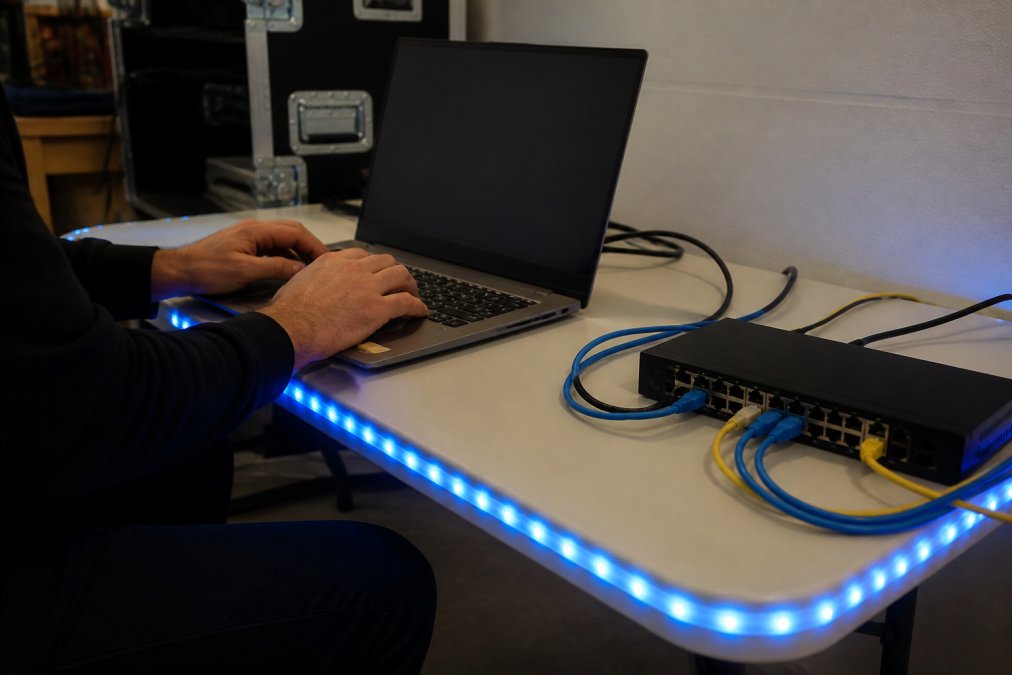
After launch, open the settings panel and confirm the subnet mask matches your network. The application should discover your Govee devices automatically. If not, check that the Govee Home app can still control them.
Step 2: QLC Plus Art-Net Configuration
QLC Plus Art-Net configuration starts in the Input/Output panel. Locate the Art-Net output plugin, enable it, and assign it to the universe you plan to use for your Govee fixtures. Set the Art-Net node's IP address to match your computer's local IP; if your network segments lighting traffic, set a unicast address pointing directly at the machine running the translation link. A common mistake is forgetting to start the Art-Net plugin, QLC+ does not transmit Art-Net until the output plugin is actively ticked.
Step 3: Patch Govee Lights as DMX Fixtures in QLC+
Open the fixture manager in QLC+ and add a new fixture. Since Govee does not publish a standard fixture definition, create a generic RGB fixture with three channels, named clearly (e.g., "Govee Strip Left"). Assign it to the same universe you enabled for Art-Net; the first Govee device starts at channel 1, the second at channel 4 if you use three channels per strip. Channel mapping must match what the link expects, DMXSmartLink reads the RGB values from your patched channels and forwards them to the corresponding Govee device. If your strip supports white or color temperature, add those channels and map them in the link's settings.
Controlling WiFi LED Strips with DMX Console
Once your fixtures are patched, controlling WiFi LED strips with a DMX console becomes identical to running any other fixture. Open the virtual console in QLC+, add a slider for each RGB channel, and move the faders; the values travel through Art-Net to the link, which translates them into Govee API calls within milliseconds. For live events, build scenes in QLC+ that recall specific looks, and assign them to buttons on the virtual console or map them to a hardware controller via MIDI. Latency on a local network is minimal; if you notice lag, check that your router is not applying QoS rules that delay broadcast traffic, and keep the control software on the same wired network segment as the lights.
DMX Pixel Mapping for LED Installations
DMX pixel mapping for LED installations takes your Govee setup beyond simple color washes, but only if you understand how the link translates QLC+'s pixel data into Govee's addressable segment commands.
How Govee Addressable Segments Actually Work
Govee's addressable strips (like the H6199 or H61A5 models) expose a fixed number of segments per controller, typically 10 to 30. Each segment is independently controllable via the LAN API, but the API does not accept a raw pixel array; instead, you send a command specifying a segment index and RGB value, or a range of segments. The control software must maintain a mapping table: when QLC+ sends a DMX universe with 90 channels for a 30-segment strip (3 channels per segment), the link reads channels 1-3 as segment 0, channels 4-6 as segment 1, and so on, then constructs a series of API calls, one per segment, sent sequentially, introducing a cumulative latency of 30-90 ms.
The Latency Problem and How to Mitigate It
Most users notice that pixel effects look "choppy" compared to native DMX fixtures. The cause is the serial nature of Govee's API. Each segment update is a separate packet, and the controller processes them one at a time. If you send 30 packets in rapid succession, the controller's buffer can overflow, causing segments to freeze or flicker.
To reduce this:
-
Batch your updates. Some Govee controllers support a range command that sets multiple segments in a single API call. Check your device's API documentation; if it supports
{"cmd": "segmentedColor", "data": {"segments": [{"start": 0, "end": 9, "color": {"r": 255, "g": 0, "b": 0}}]}}, use that instead of individual segment calls. - Lower your refresh rate. QLC+ defaults to sending DMX frames 30-40 times per second (qlcplus.org). For pixel mapping, 15-20 frames per second is visually indistinguishable for most effects and cuts the API call volume in half.
- Use a wired link host. If your translation software runs on a Raspberry Pi over WiFi, the wireless stack adds 5-10 ms per packet. Move the Pi to a wired Ethernet connection.
Building the Pixel Map in QLC+
QLC+'s RGB Matrix feature requires a fixture definition that matches your Govee strip's segment count. Create a custom fixture with one channel per segment per color, for a 10-segment RGB strip, that is 30 channels, and patch it into your Art-Net universe starting at address 1. Then open the RGB Matrix editor and define a grid: use a 1×10 grid for a single linear run, or patch multiple strips as separate fixtures and arrange them to match your physical installation. The link must know which DMX addresses correspond to which Govee segment; in DMXSmartLink, assign a starting DMX address to each Govee device and specify its segment count. If using a custom Python link, build this mapping yourself, typically with a dictionary that maps (universe, channel_start) to a Govee device ID and segment offset.
A Unique Angle: Using the API for Effects QLC+ Cannot Do
Because the link is translating to Govee's API, you are not limited to what QLC+ can express. The API supports features like built-in color temperature presets, music-reactive modes, and scene transitions that QLC+ would need multiple scenes to replicate. For example, you can patch a single DMX channel in QLC+ that the link interprets as a "mode selector": channel values 0-50 map to QLC+ pixel control, 51-100 trigger Govee's built-in music mode, and 101-150 trigger a preset scene stored on the controller. To implement this, your link needs a conditional rule, if the value on channel 1 is below 51, pass channels 2-31 through as pixel data; otherwise, ignore the pixel channels and send a mode command. This is a few lines of logic in a Python script, and DMXSmartLink exposes similar conditional routing in its advanced settings.
Testing Your Pixel Map
Before your first show, run a test pattern. In QLC+, create a simple RGB Matrix effect that sweeps a white pixel from segment 0 to segment 9. If the sweep moves smoothly left to right, your mapping is correct. If it jumps or skips segments, your DMX start address or segment count is off by one, check the link's mapping table and adjust.
Then test a multi-color gradient. This stresses the API's ability to handle simultaneous updates across segments. If you see color lag or flicker, reduce the refresh rate in QLC+ or switch to the range-based API command if your Govee model supports it.
This workflow is where a translation link earns its keep. Managing dozens of individual Govee segments directly in QLC+ would require hundreds of fixture definitions and manual channel mapping. The link handles the heavy lifting, presenting your smart strips as clean, addressable fixtures that behave predictably in the console.
Troubleshooting Common Connectivity Issues
When controlling govee lights qlc+ fails, the cause is almost always one of three issues: IP address mismatch, wrong universe, or a stopped translation service. Start by confirming your computer and Govee devices share the same subnet, Art-Net does not route across subnets by default. Next, verify the universe numbers align: if QLC+ transmits on universe 1 but the link listens on universe 2, no data packet is ever processed. Finally, confirm the control software is running and shows active input; DMXSmartLink displays incoming Art-Net activity, so if it shows no incoming data, the problem sits in QLC+'s output configuration. Work backward from the link to the console to isolate the fault.
| Problem | Likely Cause | Fix |
|---|---|---|
| No lights respond | IP subnet mismatch | Set static IPs on same subnet |
| Fixtures patched but dark | Wrong Art-Net universe | Match universe in QLC+ and link |
| Faders move, no output | Translation service stopped | Restart DMXSmartLink software |
| Intermittent response | WiFi congestion | Move link to wired connection |
Setting up control of Govee lights with QLC+ comes down to one honest assessment: the protocol gap is real, and a translation link is not optional. DMXSmartLink closes that gap by patching your smart lights as genuine DMX fixtures, so your existing console skills carry over. The software works across Mac, Windows, Pi, and Linux, supports Art-Net and sACN, and gives you a unified dashboard. Start the free 14-day trial and bring your Govee lights into the professional fold before your next show.
Frequently Asked Questions
Can QLC+ communicate directly with Govee Wi-Fi lights?
No, QLC+ cannot communicate directly with Govee Wi-Fi lights because they use proprietary wireless protocols instead of standard lighting protocols like DMX512 or Art-Net. QLC+ sends Art-Net packets over your network, but Govee lights won't recognize those packets without a translation layer. DMXSmartLink connects this gap by receiving Art-Net from QLC+ and converting those commands into the specific commands your Govee fixtures understand, making them behave like standard DMX fixtures on your console.
What hardware is required to convert smart home protocols to DMX?
To convert smart home protocols to DMX, you need a computer or dedicated device running translation software like DMXSmartLink. The software listens for Art-Net or sACN signals from your lighting console and translates them for your WiFi-based Govee fixtures. If you want to control traditional DMX gear alongside your smart lights, you also need a USB-to-DMX interface like the DMX Smart Link HUB Output Kit, which provides the physical DMX output for conventional fixtures.
How do I map Govee LED strips as DMX fixtures in QLC+?
First, confirm your Govee lights are visible to DMXSmartLink on the same network. Then, in DMXSmartLink, assign each Govee light a starting DMX channel and note its channel count for the properties you want to control, such as RGB color or brightness. In QLC+, create a new fixture with the same channel layout and universe assignment. Finally, patch that fixture into your workspace so QLC+ sends the correct Art-Net data to DMXSmartLink, which translates it to your Govee lights.
Is QLC+ open source and does it support third-party connects?
Yes, QLC+ is open-source software, which means it supports a wide range of third-party hardware and software through standard protocols. Its flexibility with Art-Net and sACN allows integration with control software like DMXSmartLink. By using these open protocols, QLC+ treats the link as another Art-Net node, enabling you to control consumer smart lights without modifying QLC+ itself. This open architecture is why QLC+ remains a popular choice for budget-conscious lighting designers and DJs.
