
Table of Contents
- Why DMX Integration for Consumer Smart Bulbs Changes Your Rig
- What You'll Need Before You Start
- Step 1: Map Smart Bulbs to DMX Channels
- Step 2: Run Art-Net and sACN to Reach WiFi Lights
- Step 3: Control Smart Bulbs with Professional DMX Lighting Software
- Step 4: Use MIDI Controllers for DMX Lighting Scenes
- Step 5: DMX Pixel Mapping for LED Installations
- Common Mistakes to Avoid
- Frequently Asked Questions
Last Updated: September 17, 2026
Why DMX Integration for Consumer Smart Bulbs Changes Your Rig
DMX integration for consumer smart bulbs means patching Wi-Fi and cloud-connected lights into a professional console as real DMX fixtures, so one desk controls both your stage pars and the smart bulbs you already own. At DMXSmartLink, we build this into a controller that speaks DMX512, Art-Net, and sACN on one side and Govee lights on the other. The payoff: no more app fumbling mid-show.
What You'll Need Before You Start
Before you patch a single bulb, confirm four things. Skipping this is the most common reason a first attempt fails mid-show.
- A controller that outputs DMX512 and network protocols. DMX Smart Link handles DMX512 output plus Art-Net and sACN, and drives Govee lights over the Govee cloud or the local network, along with anything exposed through Home Assistant or Homebridge.
- A stable network. Wired where possible. Smart bulbs live on Wi-Fi, and shared Wi-Fi with a room full of phones is where packet loss starts.
- A fixture list. Know how many bulbs you're controlling and what each one should do. A bulb that's just a wash doesn't need 16 channels.
- A test window. Patch and rehearse before the event, not during it.
Step 1: Map Smart Bulbs to DMX Channels
Patching is where smart bulbs stop being app devices and become fixtures. You assign each bulb a universe and DMX address, then describe its channels (red, green, blue, dimmer) so the console knows what to send.

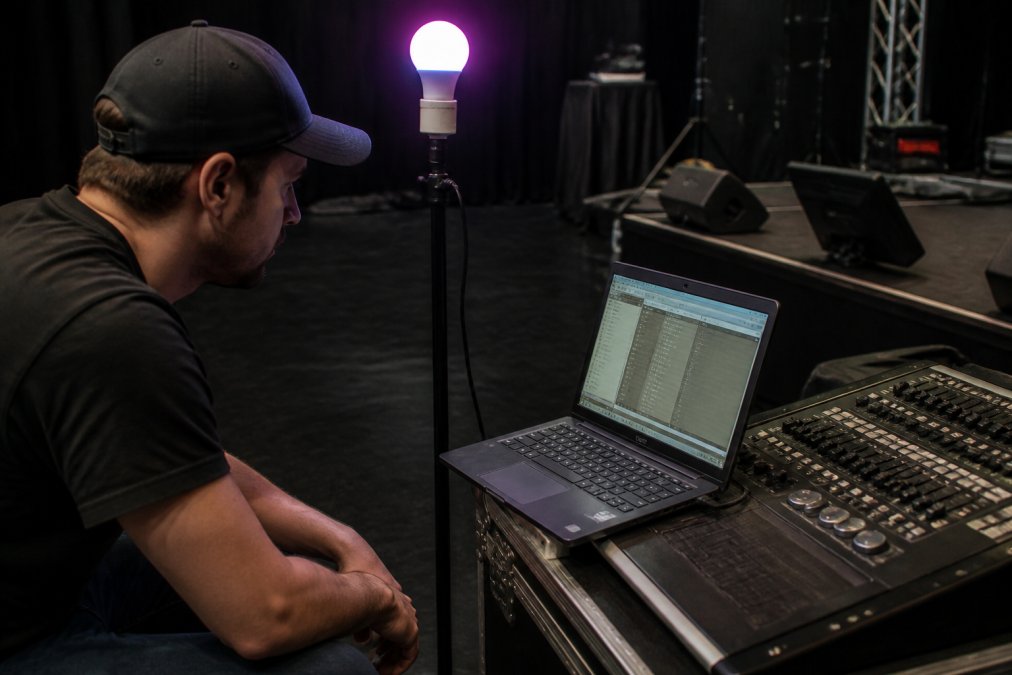
Patching Govee Lights as Fixtures
Treat each bulb like an RGB par. A single-color bulb takes one channel; an RGB bulb takes three; a tunable white bulb takes two for color temperature and dimmer. Name every fixture in the patch, not just "Bulb 1." When you're troubleshooting before a service, "Stage Left Wash" tells you far more than an address number.
Assigning Universes and Addresses
A DMX universe carries 512 channels. Keep smart bulbs in their own universe rather than mixing them with moving heads, so a bulb dropout never disturbs your stage fixtures. Address them sequentially and leave gaps for growth.
Step 2: Run Art-Net and sACN to Reach WiFi Lights
Art-Net and sACN carry DMX data over Ethernet and UDP, which is how a console reaches fixtures it can't cable directly. Your controller receives that network data and translates it into commands the smart bulbs understand. Both move the same 512-channel universe; they differ in addressing and who maintains them.
Network configuration that survives a show
The practical setup: run a dedicated switch for lighting, give the controller a static IP address, and keep lighting traffic off the guest Wi-Fi. A common pattern is a lighting VLAN on its own subnet, with the controller on a fixed address so your console always finds it.
- Put the controller and any Art-Net nodes on the same subnet, for example 10.0.0.x with a 255.255.255.0 mask.
- Set the controller to a static address outside your router's DHCP pool so it never changes between events.
- Disable energy-saving and Wi-Fi sleep on the control laptop; a sleeping network adapter drops Art-Net packets silently.
- Keep smart bulbs on a separate access point or SSID from guest devices whenever the venue allows it.
Measuring latency instead of guessing
Latency is the number that matters, and you can measure it without special gear. Point a phone at the fixture in slow-motion video mode, fire a scene from the console, and count the frames between the cue and the bulb changing. At 240 frames per second, each frame is roughly 4 milliseconds, so a bulb 12 frames late is about 50 ms behind.
A common pattern in real rooms:
- Local network control of Govee lights through Home Assistant with color changes in under 0.3 s, fast enough to sit inside a music cue.
- Cloud-routed control adds a round trip to a remote server and back, which is why it drifts noticeably on beat-synced cues.
- Wired Art-Net or sACN to a DMX fixture is effectively instant by comparison, so the smart bulbs are almost always the slow element in the chain.
Step 3: Control Smart Bulbs with Professional DMX Lighting Software
Professional DMX lighting software turns patched fixtures into a show. Your console or software builds the cues, and the controller executes them on the smart bulbs. DMX Smart Link speaks Art-Net and sACN, so Lightkey, QLC+, or Madrix can feed it directly. If your team already knows one desk, you keep the interface you've rehearsed on and add smart lights underneath it, running fixtures and bulbs from a single dashboard instead of two apps.
API control versus protocol control
This is the distinction most guides skip, and it explains nearly every reliability complaint about smart bulbs on a DMX rig.
Matching software to the job
- QLC+ is free, runs on Windows, macOS, Linux, and Raspberry Pi, and handles a few universes of smart bulbs plus conventional fixtures without complaint. It is the usual starting point for churches and small venues.
- Lightkey is macOS and Windows, with a strong cue-list workflow and MIDI learn, which pairs well with a pad controller.
- Madrix is built for pixel and matrix work, so it is the choice when your smart bulbs are part of a larger LED installation rather than a handful of washes.
For rooms with a console already feeding DMX, the Pro Dual I/O Kit takes a live DMX input and outputs at the same time, so you blend smart lights into an existing rig without rebuilding it. The Network Edition drives stage lights through any Art-Net node you already own and runs on Windows, macOS, Ubuntu, or a Raspberry Pi.

| Setup | DMX Interface | Best For |
|---|---|---|
| Network Edition | Add-on needed | Stage lights over Art-Net nodes plus smart lights |
| Output Kit (Basic) | 1x USB-DMX | A few pars or uplights, small rooms |
| Pro Output Kit | 1x pro USB-DMX | Venues, churches, DJs |
| Pro Dual I/O Kit | 2x pro USB-DMX | Consoles feeding DMX in |
Step 4: Use MIDI Controllers for DMX Lighting Scenes
Using MIDI controllers for DMX lighting scenes puts physical controls back in your hands. Instead of hunting through a screen mid-set, you hit a pad and the scene fires.
Step 5: DMX Pixel Mapping for LED Installations
DMX pixel mapping for LED installations extends the same patching logic to hundreds of individual pixels. Each pixel becomes a channel group, and the controller sends a full frame every refresh cycle.
Common Mistakes to Avoid
These failures account for most first-time problems, and each has a straightforward fix.
- Mixing smart bulbs into your stage universe. Give them their own universe so a dropout doesn't ripple into your fixtures.
- Running lighting traffic on shared Wi-Fi. Use a dedicated switch or VLAN.
- Skipping the rehearsal. Patch and run the full show once before the event, in the room, with the network live.
- Forgetting a fallback. If the control machine restarts, know which scene you'll recall manually while it comes back. DMX Smart Link runs with no internet connection once licensed, which removes one dependency from the chain.
- Over-addressing a single bulb. A wash bulb doesn't need 16 channels. Simple patches fail less.
Frequently Asked Questions
Can consumer smart bulbs be controlled by a DMX console?
Yes, with the right software layer. DMX Smart Link patches Govee lights and other WiFi bulbs as real DMX fixtures, so your console sees them like any par or wash. The software translates DMX512, Art-Net, or sACN output into commands the bulb understands. You keep using your console, and the smart bulbs respond to channel fades and scene recalls the same way hardwired fixtures do.
What causes flicker or lag when mixing smart bulbs into a DMX rig?
Two things usually. Network latency hits first: WiFi bulbs receive commands over UDP packets, so a congested access point adds delay between your console and the bulb. Second, some bulbs have a coarse dimming curve, which makes low-level fades look steppy. Run bulbs on a dedicated access point, keep universes small, and test fades at 10 percent before showtime. Local control through Home Assistant cuts colour-change delay noticeably.
Do I need professional DMX lighting software to run smart bulbs on stage?
You need software that speaks both protocols. The DMX Smart Link HUB ships with software preinstalled that outputs DMX512, Art-Net, and sACN, and also drives Govee lights over the Govee cloud or your local network. It runs on Windows, macOS, Ubuntu, and Raspberry Pi, and it can take a feed from consoles you already use. That means one dashboard for your stage fixtures and your smart lights.
How do MIDI controllers fit into a DMX smart bulb setup?
USB MIDI controllers give you hands-on scene recall without touching a laptop. With DMX Smart Link, pads recall saved scenes, a fader on CC 7 rides the master level, and CC 20 and CC 21 step through scenes. That works well for DJs and church volunteers who need one-press changes mid-service or mid-set. Map your most-used scenes to pads and leave the console for bigger changes.
Running smart bulbs alongside professional fixtures is a solvable problem, but it needs a controller built for both worlds rather than a consumer app stretched past its limits. DMXSmartLink patches Govee and smart lights as real DMX fixtures, speaks Art-Net and sACN to the console your team already knows, and runs on Mac, PC, Pi, or Linux from a single dashboard. Start the free 14-day trial, no credit card required, and run your next service or set with every light on one desk.
