
Table of Contents
- 1. Why App-Only Control Fails During a Live Set
- 2. The Fastest Ways to Control Smart Lights for DJs
- 3. MIDI Lighting Control for DJs: Pads, Faders, and Scenes
- 4. DMX Pixel Mapping for LED Installations
- 5. Integrating Smart Lights With Lightkey
- 6. Latency, Wi-Fi, and Keeping the Show in Time
- 7. A Budget Path to DMX Control of Smart Lights
- Frequently Asked Questions
Last Updated: September 13, 2026
1. Why App-Only Control Fails During a Live Set
The single biggest reason DJs lose control of their lighting mid-set is that consumer apps are built for a sofa, not a stage. Tapping through three menus to change a color while a track is peaking is a guaranteed way to kill the energy in the room.
App-only control fails for three reasons. First, it demands your eyes and hands at the exact moment you're mixing. Second, every brand has its own app, so a rig with two light types means two phones or constant switching. Third, there's no way to save and recall a full scene across every fixture at once.
Mobile DJs and church techs describe the same problem: the lights are fine until the moment you need to change them fast. This guide from DMXSmartLink breaks down effective ways to control smart lights for DJs.
2. The Fastest Ways to Control Smart Lights for DJs
The fastest method is a dedicated DMX controller that treats your smart lights as real fixtures, because it lets you recall a saved scene with one button press instead of digging through an app. Speed comes down to how few taps stand between you and the change.
Quick Comparison: Five Control Methods
| Method | Response Speed | Setup Effort | Best For |
|---|---|---|---|
| Phone app only | Slow, menu-heavy | None | Static room lighting |
| Voice assistant | Unreliable on beat | Low | Home studios |
| Music-reactive software | Automatic | Medium | Solo streamers |
| MIDI controller | Instant, tactile | Medium | Live DJs |
| DMX controller | Instant, recallable | Higher | Venues and churches |
How We Evaluated These Methods
We judged each method on four things: how fast you can trigger a change, whether it survives a crowded Wi-Fi band, how much gear it needs, and whether it scales from a bedroom to a full stage. A method that works for a solo streamer often collapses in a venue with fifty phones competing for airtime.
The pattern is consistent. The more tactile the control, the faster the show.
3. MIDI Lighting Control for DJs: Pads, Faders, and Scenes
MIDI lighting control for DJs is the practice of mapping lighting scenes to physical pads and faders, so a trigger is a button press rather than a screen tap. It's the closest thing to playing your lights like an instrument.
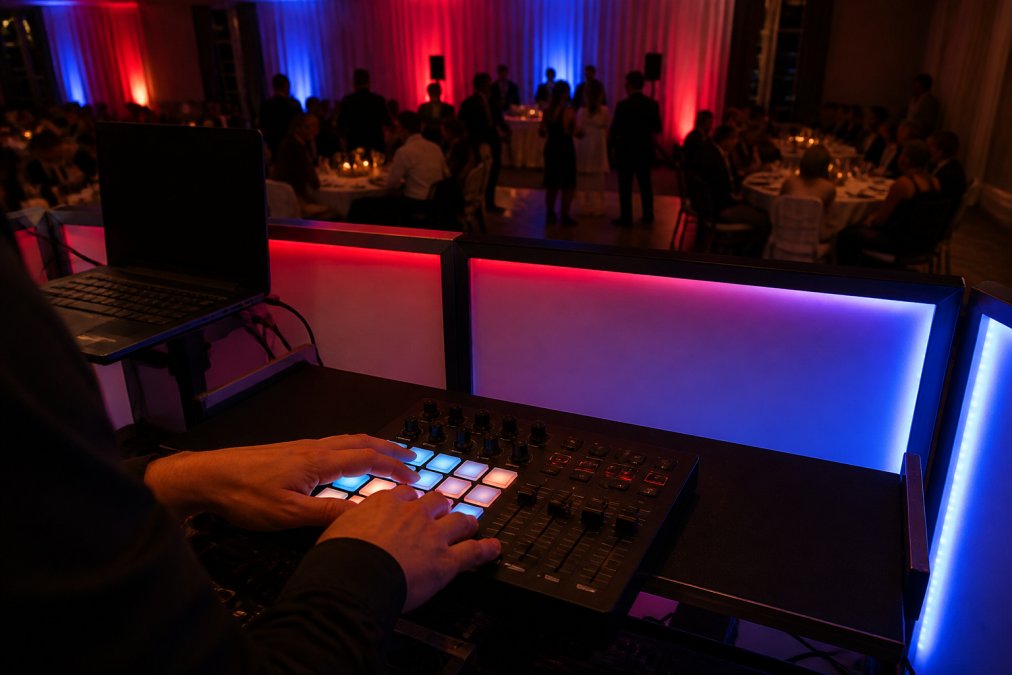
The mapping most DJs settle on is simple. Pads recall saved scenes, a fader on CC 7 rides the master level, and CC 20 and CC 21 step through scenes one at a time. That gives you instant blackout, instant full wash, and a way to walk a build-up without lifting your eyes off the decks.
4. DMX Pixel Mapping for LED Installations
DMX pixel mapping for LED installations means addressing each LED or small group of LEDs as its own fixture, so you can run patterns, chases, and gradients across a strip instead of treating it as one solid color. It's what separates a wall that pulses with the music from a wall that just glows.
The practical limit is channel count. One DMX universe carries 512 channels, and a dense strip eats them fast, so large installations use multiple universes mapped across a network. This is where Art-Net and sACN earn their keep, carrying many universes over Ethernet instead of a single cable.
For DJs, pixel mapping shines on backdrop panels and booth fascias. For churches and small theaters, it turns a fixed set piece into something that shifts with the service or scene.
5. Integrating Smart Lights With Lightkey
Integrating smart lights with Lightkey works by feeding your smart fixtures into the console as DMX channels, so Lightkey drives them alongside your stage lights. The smart lights stop being a separate system and become part of the rig.
The catch is the same one that trips up most hybrid setups: consumer lights don't speak DMX natively. Something has to translate. DMX Smart Link is a professional DMX lighting controller that controls Govee and other smart lights as real DMX fixtures, speaking Art-Net and sACN into the console you already run. It works with Lightkey, QLC+, grandMA, and any console that accepts those protocols.

6. Latency, Wi-Fi, and Keeping the Show in Time
Latency is the delay between the command and the light change, and it's the number one reason wireless smart lighting looks sloppy on a beat. A quarter-second lag is invisible on a static wash and glaring on a strobe.
Three things keep latency down. Put the controller on Ethernet with a fixed IP rather than relying on Wi-Fi. Keep smart lights on a solid 2.4 GHz network, since that band travels farther through a crowded room. And avoid stacking dozens of devices on one access point.
Local control beats cloud control for timing. When a controller talks to lights over the local network instead of round-tripping through a cloud server, changes land far closer to the beat. The Wi-Fi Alliance guide to network performance is worth reading if you're troubleshooting dropouts in a packed venue.
7. A Budget Path to DMX Control of Smart Lights
A budget path to DMX control exists, and it starts with software rather than hardware. If you already own a laptop or a Raspberry Pi, a software license gets you running before you buy a single interface.
DMX Smart Link runs on Windows, macOS, Ubuntu, and Raspberry Pi, and there's a free 14-day trial with no credit card, so you can test the whole workflow on your own lights first. When you're ready to send DMX out of a cable, the entry-level interface is the OpenDMX USB-to-DMX output, which suits hobby and budget setups. For anything mission-critical, step up to a buffered, hardware-timed interface so the output stays flicker-free under load. The official DMX512 standard overview explains why timing matters at the protocol level.
The Elgato Stream Deck product page is also worth a look if you'd rather press labeled keys than remember pad numbers. Stream Deck and YoloDeck support turns every saved scene into a key.
If you want it working out of the box, the DMX Smart Link HUB arrives configured with the software installed and licensed. See the HUB and current pricing at the store.
Frequently Asked Questions
How do DJs sync smart lights to their music?
Most DJs feed audio into lighting software from the mixer's booth output, a USB sound card, or Bluetooth from a phone, then let the software read the beat and drive the fixtures. DMX Smart Link can take that audio and move every fixture and smart light with the beat, or you can describe the feel you want in a sentence and it builds the show. Save the result as a scene and recall it with one press when the track drops.
Can I use consumer smart lights in a professional DJ lighting setup?
Yes, and plenty of mobile DJs already do. The catch is control. Smart light apps are built for one-off taps, not a live set, so you need software that treats each Govee light as a real DMX fixture. DMX Smart Link controls Govee and other smart lights alongside your DMX fixtures, so scenes with fades recall from a phone, tablet, or browser instead of you hunting through an app mid-song.
Is it possible to control Govee lights from a DMX console?
It is, once the Govee lights are patched as DMX fixtures. DMX Smart Link speaks Art-Net and sACN, so a console or lighting program can feed it directly, and the software translates that into commands the Govee lights understand over the Govee cloud or your local network. You can also skip the console and run everything from the built-in dashboard on a Mac, Windows PC, or Raspberry Pi.
How can I trigger lighting scenes using a MIDI controller?
DMX Smart Link supports USB MIDI controllers directly. Pads recall saved scenes, a fader on CC 7 rides the level, and CC 20 and CC 21 step through your scene list. That means a small pad controller on your booth can fire your intro scene, your drop scene, and your walk-off without touching a laptop. Set the scenes up before the gig and the pads become your show controls.
What causes latency between my smart lights and the music?
Most delay comes from the network, not the software. Put the controller on Ethernet with a fixed IP and keep Govee lights on a solid 2.4 GHz Wi-Fi band rather than a crowded 5 GHz one. Local control through Home Assistant brings color changes in under 0.3 seconds. If lights still lag, check for other devices saturating the same access point during the event.
The hard part of controlling smart lights for DJs isn't the lights. It's getting them to obey one interface under pressure, on beat, in a room full of interference. DMXSmartLink closes that gap by patching Govee and smart lights as real DMX fixtures, running on Mac, PC, Pi, or Linux, and speaking Art-Net and sACN to the console you already trust. Start the free 14-day trial, no credit card required, and run your whole rig from one dashboard.
