
Table of Contents
- Why Affordable DMX Lighting Matters for Small Venues
- DMX Lighting Controller for Beginners: Understanding the Basics
- How to Patch Smart Lights Into DMX: A Practical Approach
- Budget Tiers for Affordable DMX Lighting Setups
- DMX Lighting Setup Guide for Bands and Live Performers
- Venue Space and Ceiling Height Considerations
- Portable vs. Permanent Installation for Small Venues
- Software-Based DMX Control: A Modern Alternative
- Getting Started With Affordable DMX Lighting
- Frequently Asked Questions
Last Updated: September 3, 2026
Why Affordable DMX Lighting Matters for Small Venues
Running lights for a small venue forces a choice: spend thousands on professional gear or settle for consumer smart lights with no real control. The real problem is patching together solutions never designed to work together, a Govee light here, a DMX fixture there, multiple apps, until something disconnects mid-performance.
At DMXSmartLink, we've learned that affordable DMX lighting isn't about buying the cheapest gear. It's about choosing the right control layer that lets your existing equipment, whether professional DMX fixtures or budget smart lights, actually talk to each other.
DMX Lighting Controller for Beginners: Understanding the Basics
A DMX lighting controller sends commands to every light in your setup, telling each one what color to be, how bright to shine, and when to change. The most common confusion: people think they need an expensive hardware console. They don't. A DMX controller can be software running on a computer, a dedicated hardware unit, or a hybrid approach. For small venues, software-based control is often the smartest choice.
DMX512 Protocol and Channel Addressing
DMX512 is the industry standard protocol for lighting control. The "512" refers to 512 channels per universe, 512 individual control channels that can address fixture parameters like color, intensity, and strobe speed.
Each fixture gets assigned a DMX address. If a PAR uses 4 channels, you might assign it to address 1-4. The next fixture starts at address 5. Your controller sends data down the chain, and each fixture listens for its own address range. This daisy-chaining lets you scale from one light to dozens without separate cables for each one.
A common mistake is assigning overlapping addresses. If two fixtures both listen to channel 1, they'll both respond to the same command. Address planning takes five minutes and saves hours of troubleshooting.
Essential Fixture Types: PARs, LED Bars, and Strobes
LED PARs are the workhorse. They cost $30-80, run cool, and are simple to control via DMX. A 36W RGB LED PAR is bright enough for accent lighting in venues under 2,000 square feet. The trade-off: they're not as bright as halogen PARs, and color mixing can look flat.
LED Bars are long, narrow fixtures excellent for cyc lighting or stage wash. A 1-meter LED bar costs $50-150 and provides even coverage without tight spotlighting.
Strobes create rapid on-off effects. LED strobes ($50-150) are cheaper and more reliable than xenon strobes ($200-500), though slightly less punchy.
For a small venue on budget, 4-6 LED PARs plus 1-2 LED bars gives flexibility without breaking the bank. Total fixture cost: $300-600.
How to Patch Smart Lights Into DMX: A Practical Approach
You've got a Govee light strip and a DMX console, but no obvious way to make them talk. Govee speaks Wi-Fi and Bluetooth, not DMX. The solution is a link: software that translates DMX commands into Govee commands. DMXSmartLink does exactly this, patching your Govee lights as standard DMX fixtures.
Step 1: Install the software on your control device (Mac, Windows PC, Raspberry Pi, or Linux). DMXSmartLink includes a free 14-day trial with no credit card required.
Step 2: Connect your Govee lights to Wi-Fi using the Govee app.
Step 3: In the software, assign each light a DMX address and universe. Now they're addressable like traditional DMX fixtures.
Step 4: Send Art-Net or sACN data from your console (QLC+, Lightkey, grandMA) to the DMXSmartLink hub. The software translates that data into Govee commands.
Budget Tiers for Affordable DMX Lighting Setups
Entry-Level: Under $100
Assumes you already own some lights and need software control.
What you get:
- DMXSmartLink software license ($99.99/year)
- Basic USB-to-DMX interface ($29.99) if needed
Best for: DJs using Govee lights, churches with smart bulbs, streamers syncing lights to music.

Mid-Range: $300-$500
Adds physical DMX output and a ready-to-run hub.
What you get:
- DMX Smart Link HUB - Network Edition ($299.00) or Output Kit ($349.00)
- Pre-configured Raspberry Pi with software installed
- 1-year software license included
Best for: Small theaters, mobile DJs, churches upgrading from manual control.
Real-world example: A church with 8 LED PARs, 4 smart light zones, and a strobe can run everything from one DMX Smart Link HUB. Setup takes under an hour. Total fixture cost: $400-600. Total control cost: $299.00-$349.00.
Professional Grade: $500+
Adds bidirectional DMX control and pro-grade hardware.
What you get:
- DMX Smart Link HUB - Pro Output Kit ($535.99) or Pro Dual I/O Kit ($705.99)
- Professional ENTTEC USB-DMX interface
- Support for simultaneous DMX input and output (Dual I/O only)
- 1-year software license included
Best for: Event production companies, large venues, touring rigs.
| Budget Tier | Starting Cost | Best For | Key Limitation |
|---|---|---|---|
| Entry-Level | $99.99/year | Smart light control via DMX | No physical DMX output without separate interface |
| Mid-Range | $299.00-$349.00 | Small venues, churches, mobile DJs | Output only (no simultaneous input) |
| Professional | $535.99-$705.99 | Large rigs, touring, complex installs | Higher cost than needed for most venues |
DMX Lighting Setup Guide for Bands and Live Performers
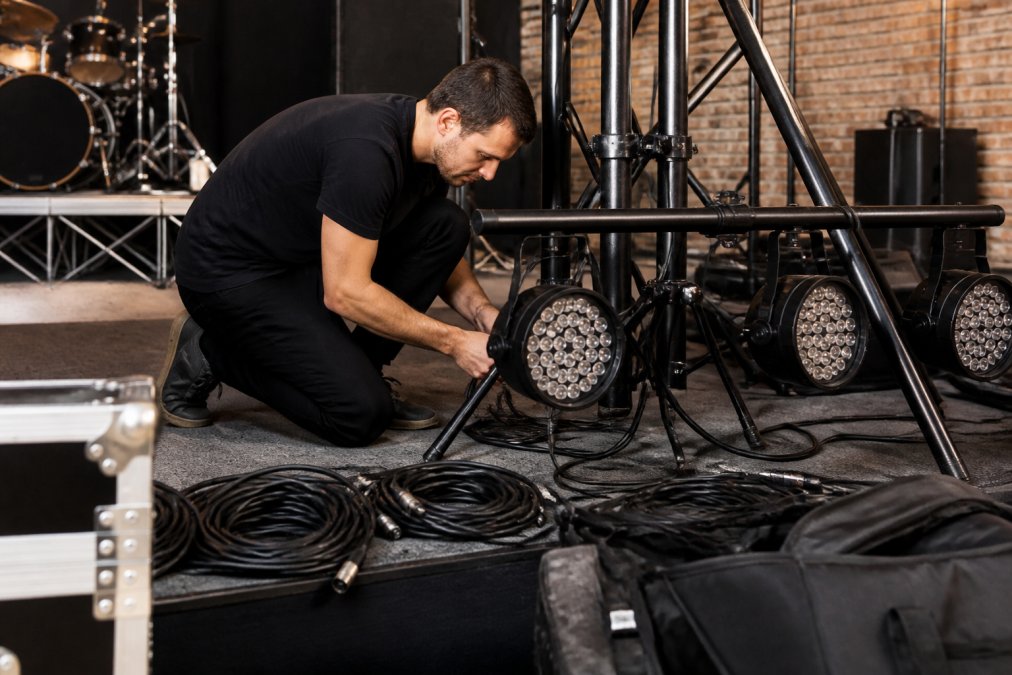
Start with a cable plan. Map out where your controller will sit, where lights will hang, and how long DMX cables need to be. Plan for 20% extra cable length for slack and routing.
Power Distribution and Cable Management
A single 20-amp circuit safely powers about 2,400 watts. Four LED PARs, one strobe, your controller, and audio equipment can easily exceed this. Use a power distribution unit (PDU) costing $30-50 to spread load across multiple circuits.
Label every cable at both ends. Coiled DMX cables can degrade signal if coils are too tight. Use velcro straps to secure cables along trusses, keeping them away from power cables.
Daisy-Chaining Fixtures and Avoiding Common Mistakes
Daisy-chaining connects one fixture's DMX output to the next fixture's DMX input, creating a chain.
Correct order: Controller → Fixture 1 (DMX IN) → Fixture 1 (DMX OUT) → Fixture 2 (DMX IN) → and so on.
Common mistake #1: Connecting the controller directly to multiple fixtures with separate cables. Use a DMX splitter instead. The ENTTEC D-Split ($133.00) or GAMMA DMX Splitter 8 ($184.00) are affordable and reliable.
Common mistake #2: Leaving the last fixture's DMX OUT unconnected. Terminate it with a 120-ohm resistor plug ($5-10) to prevent signal reflections that cause flickering.
Common mistake #3: Mixing 3-pin and 5-pin DMX connectors without adapters. The GAMMA 5 to 3 Pin DMX Adapter ($13.00) lets you connect them.
A properly daisy-chained rig with 8-10 fixtures runs from a single DMX cable. Beyond that, use a splitter to divide the load.
Venue Space and Ceiling Height Considerations
Physical space dictates what fixtures work and where they go. In low-ceiling venues (8-12 feet), avoid narrow beam angles. Use 25-40 degree angles that spread light evenly. LED bars work especially well because they throw a wide wash without needing to hang high.
In high-ceiling venues (16+ feet), tighter beam angles work well and let you position lights farther away for more dramatic effects.
Test fixture placement during soundcheck. Adjust beam angle or move fixtures forward or back until coverage feels right.
For regular venue rentals, ask about installing a small truss system. A 10-foot truss section costs $100-200 used and provides a professional mounting point more stable than stands.
Portable vs. Permanent Installation for Small Venues
Portable rigs work for mobile DJs, touring bands, and event production. Your entire setup fits in road cases. Advantages: flexibility, quick setup (under 2 hours), easy transport. Disadvantages: messier cable management, dependent on finding suitable power and rigging at each venue.
Permanent installations work for venues hosting events regularly, churches, small theaters, nightclubs. Fixtures are mounted, cables run through walls, controller lives in a rack. Advantages: no setup time, professional appearance, reliable infrastructure. Disadvantages: higher upfront cost, harder to modify.
For most small venues, a hybrid approach works best. Mount 4-6 fixtures permanently (wash lights, cyc lights) and keep 2-3 portable fixtures (PARs, strobes) for special events. The DMX Smart Link HUB works for both: it runs on a Raspberry Pi in a portable case or sits in a permanent rack.

Software-Based DMX Control: A Modern Alternative
Software-based DMX control has matured into a legitimate alternative to traditional consoles, especially for venues that don't need real-time fader control during shows.
QLC+ is free, open-source, and surprisingly capable. It handles DMX output, controls moving lights, and supports plugins. The learning curve is steep for non-technical users, but you get a professional-grade controller for nothing.
Lightkey is commercial software ($99-199) designed for DJs and small venues. It's more intuitive than QLC+, includes built-in music synchronization, and has a library of pre-built effects.
DMXSmartLink connects consumer smart lights and professional software. Use any software controller (QLC+, Lightkey, grandMA) and control both traditional DMX fixtures and Govee smart lights from the same interface. The software sends Art-Net or sACN data to the DMXSmartLink hub, which translates it for your smart lights and outputs physical DMX for traditional fixtures.
Getting Started With Affordable DMX Lighting
The path to affordable DMX lighting isn't about finding the cheapest fixtures. It's about choosing the right control layer and building intelligently within your budget.
Start small. Pick 3-4 LED PARs and test them with whatever control method makes sense. If you're a DJ using Govee lights, start with the DMXSmartLink software license ($99.99/year). If you're a church or venue with traditional DMX fixtures, the DMX Smart Link HUB - Output Kit ($349.00) gives you everything pre-configured and ready.

Test during a real show, not just soundcheck. You'll learn what works and what doesn't. The biggest cost savings come from avoiding setup mistakes: overlapping DMX addresses, power overloads, poor cable management, and trying to control smart lights from their apps instead of a unified DMX interface.
DMX512 protocol specification and standards
LED lighting efficiency and power consumption guidelines
Professional lighting design best practices for live events
Building affordable DMX lighting for small venues doesn't require expensive hardware or years of technical experience. The real challenge is choosing control software that connects consumer smart lights and professional fixtures without forcing you to juggle multiple apps mid-show.
DMXSmartLink solves that problem. Patch your Govee lights and traditional DMX fixtures into one dashboard, save your scenes, and control everything from QLC+, Lightkey, or any Art-Net compatible console. The DMX Smart Link HUB - Output Kit ($349.00) includes everything you need: pre-configured hardware, a year of software, and physical DMX output built in. Start with the free 14-day trial to test it on your own rig first, no credit card required.
Frequently Asked Questions
Q: What is the cheapest way to start with affordable DMX lighting for small venues?
A: Start with software-based DMX control using your existing computer or a Raspberry Pi. The DMX Smart Link Software ($99.99/year) lets you control Govee smart lights over your network without physical DMX cables. Add a basic USB-to-DMX interface ($29.99) only if you need to control traditional DMX fixtures. This approach costs under $110 upfront and scales as your venue grows.
Q: How do I patch smart lights into DMX without replacing my existing console?
A: Use a DMX link that speaks Art-Net or sACN. Your existing console sends DMX over Ethernet to the control software, which converts it to control commands for Govee or other smart lights. No console replacement needed. The DMX Smart Link HUB (Network Edition, $299.00) handles this conversion automatically, or run the software on your own Mac, PC, or Raspberry Pi for maximum flexibility.
Q: What happens if DMX software crashes during a live performance?
A: Professional setups use redundancy: save your lighting scenes before the show, keep a backup controller, and test failover procedures during soundcheck. DMX Smart Link includes scene recall (save your full rig state and restore it with one button), so recovery is fast. For mission-critical venues, the Pro Dual I/O Kit ($705.99) adds simultaneous DMX input and output, letting you fall back to a traditional console if software fails.
Q: Can I use affordable DMX lighting in different venues with different rigs?
A: Yes, software-based control travels with you. DMX Smart Link runs on Mac, Windows, Raspberry Pi, or Linux, so you can bring it to any venue. It supports Art-Net and sACN over Ethernet, which works with nearly every modern lighting console. Portable USB-DMX interfaces like the Open DMX USB ($67.00) plug into any computer, making your setup venue-agnostic.
